The First Cycle: Testosterone Only
The complete guide to planning a first testosterone cycle, why test-only is the universal starting point, ester selection, dosing logic, cycle length, and what to realistically expect week by week.
- Explain why testosterone-only is the correct starting protocol for beginners
- Choose between Testosterone Enanthate and Testosterone Cypionate with a clear rationale
- Structure a first cycle at an appropriate dose and duration
- Set realistic week-by-week expectations for strength, weight, and side effects
- Understand the baseline bloodwork requirement and its role in informed cycle planning
On this page
Why Testosterone First: And Only Testosterone
The near-universal recommendation from experienced practitioners, harm-reduction communities, and the limited clinical literature on performance-enhancing compound use is unambiguous: the first cycle should be Testosterone only. The recommendation is logically sound, based on what a first cycle is actually for.
A first cycle serves two purposes simultaneously. The first is physiological: to introduce supraphysiological androgens and observe the adaptation. The second, and arguably more important, is informational: to learn how your specific body responds to exogenous testosterone. How much do you aromatize? How does your skin react? How does your blood pressure change? How do your lipids behave? How does your sleep, mood, and aggression shift? These are questions with individual answers, and the only way to gather clean data is to run a single, well-characterised variable.
If you add Dianabol as a kickstart and Nandrolone to the base and then develop gynecomastia in week eight, you have no idea which compound, or which interaction, is driving it. If you develop severe acne on week four, you cannot determine whether it is the Testosterone, the Dianabol, the Nandrolone, or the specific carrier oils in use. Running multiple unknowns on your first cycle does not make the cycle more productive. It makes the data it generates uninterpretable.
Testosterone is also the ideal solo compound because it is anabolic and androgenic in a balanced ratio, it provides a complete hormonal environment (unlike compounds that require test as a base to maintain libido and wellbeing), it aromatizes to estradiol predictably, and its side effect profile is the best-characterised of any compound in this space. Every other compound in existence was compared against Testosterone in whatever clinical or experimental data exists on it. Starting with the benchmark compound is the rational choice.
The gains from testosterone alone are also meaningfully significant for a first-time user. Protein synthesis and nitrogen retention increase substantially above natural levels, which means that at 300–500 mg/week of Testosterone, most beginners will make better gains than they have at any point in their natural training career. There is no need to add complexity to achieve compelling results on a first cycle.
Choosing an Ester: Enanthate vs. Cypionate
For a beginner, the ester choice effectively comes down to Testosterone Enanthate (Test E) versus Testosterone Cypionate (Test C). These two esters are clinically and practically interchangeable for almost all purposes, and the difference between them matters far less than any other variable in your cycle plan. Both have half-lifes of approximately 6–9 days. Both reach steady-state blood levels (known as saturation) at approximately the same rate. Both are typically injected twice weekly.
The primary differences are regional availability and carrier oil conventions. Test Cypionate is the dominant US pharmaceutical testosterone formulation; Enanthate is more common in Europe and international pharmaceutical supply. Underground lab production of both is widespread globally. If you have reliable access to both, choose whichever you can verify is from a more reputable source, ester differences at equivalent doses are functionally negligible.
What you are not selecting as a beginner are short-ester formulations like Testosterone Propionate. Propionate has a half-life of approximately 2–3 days and requires injection EOD (every other day) or even daily ED administration to maintain stable blood levels. This is a meaningful practical burden for someone new to pinning, and the more frequent injection schedule also means higher aggregate injection site trauma and PIP. More importantly, the rapid blood level changes of Propionate make AI management trickier, estradiol rises and falls more steeply between injections, making it harder to calibrate. Long-ester Testosterone for your first cycle is an unambiguous recommendation.
Dosing: The Logic Behind 300–500 mg/Week
The standard beginner dose range of 300–500 mg/week of Testosterone Enanthate or Cypionate is well-established, and the logic behind it deserves understanding rather than simply accepting.
At 300 mg/week, most men achieve blood levels of total testosterone in the range of 1,500–2,500 ng/dL, roughly 3–5× their natural production. At this range, the anabolic signal is meaningfully supraphysiological, but estradiol elevation and side effect burden are relatively modest. Most beginners respond well at this dose and experience substantial gains in strength and lean mass.
At 500 mg/week, testosterone blood levels typically land in the 2,500–4,000+ ng/dL range. The anabolic return is higher, but so is aromatization to estradiol, the need for AI management, and the stress on hematocrit and lipid profiles. The dose-response curve for anabolic effect is not linear above a certain point, going from 300 to 500 mg/week does not produce proportionally more muscle than going from 0 to 300. The incremental benefit above 400 mg/week for a first-cycle beginner is modest relative to the incremental risk.
A reasonable heuristic: if you are cautious by nature, want to minimise AI complexity, and prioritise information gathering over maximum gains on your first run, start at 300–350 mg/week. If you are comfortable with the monitoring requirements, have your estradiol management plan in place, and want more pronounced first-cycle results, 400–500 mg/week is well within the established beginner range. Going above 500 mg/week on a first cycle has no clear justification, you are adding risk to a situation where you have insufficient data about your own response to inform the decision.
The split of your weekly dose across two injections is standard practice for long-ester testosterone. 500 mg/week becomes 250 mg Monday/Thursday, or any similar arrangement that spaces injections roughly 3–4 days apart. Even spacing maintains more consistent blood levels and reduces peak-to-trough variation in estradiol, which simplifies AI dosing decisions.
Cycle Length: 10–16 Weeks
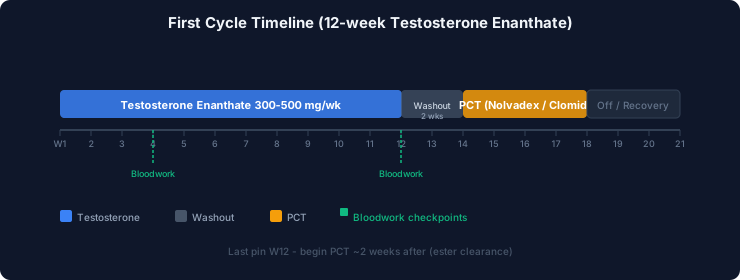
The commonly cited first-cycle range of 10–16 weeks reflects the pharmacokinetics of long-ester Testosterone and the biology of the anabolic adaptation curve.
Long-ester testosterone takes approximately 4–5 half-lifes, roughly 4–5 weeks, to reach full saturation in the blood. This means that in a 10-week cycle, you are operating at full steady-state blood levels for only approximately 5–6 weeks, with the first several weeks representing a gradual approach to target levels. In a 16-week cycle, you have approximately 10–11 weeks at saturation. More time at stable target levels generally means more opportunity for anabolic adaptation.
The case for not going shorter than 10 weeks is simple: you are not getting full benefit from the compound at full saturation for enough time to justify the suppression, the PCT recovery period, and the physiological cost of the cycle if you are only getting 4–6 weeks of meaningful supraphysiological stimulus.
The case for not going longer than 16 weeks on a first cycle is primarily about recovery. Suppression of the HPTA is dose- and duration-dependent. Longer cycles mean longer suppression and, generally, more difficult recovery. For a first cycle, with no data on how robustly your HPTA responds to PCT, a 12–14 week window is a reasonable balance between sufficient cycle duration and a manageable recovery demand.
What to Expect, Week by Week
The first two to three weeks of a long-ester testosterone cycle will feel almost nothing like the full “on” experience. Blood levels are rising slowly toward saturation. Most users report little in this phase beyond perhaps a mild increase in aggression or libido and slightly increased pump in the gym.
Weeks three to four are when early indicators begin to appear. Water retention becomes noticeable as estradiol begins to rise meaningfully with rising testosterone levels. The scale may move up noticeably, often 3–6 lb in a relatively short period, driven almost entirely by estradiol-mediated water and glycogen retention. This is expected and is not fat gain. Strength numbers start to climb more aggressively than baseline training would produce.
Weeks five through eight represent the transition to full saturation and typically the most dramatic subjective experience of the cycle. Strength increases are substantial, 30–50 lb on compound lifts over a cycle is not unusual for a beginner with good training. Recovery between sessions improves noticeably. Muscle fullness from nitrogen retention and cellular hydration is visually apparent. Libido typically increases significantly. This is also when most side effects, acne, potential gynecomastia sensitivity, mood changes, become evident if they are going to appear.
Weeks nine through end of cycle (whether that is week 12, 14, or 16) typically is a period of continued but slower accumulation. The dramatic initial strength leap stabilises. Some users continue gaining at a meaningful rate; others find gains plateau as the body adapts. Maintaining weight and strength by the end of the cycle while retaining body composition improvements is the realistic expectation, not continuous linear progress throughout.
After the last injection, blood levels decline over 2–3 weeks as the ester clears, and this is when many users notice a tangible drop in performance, recovery, wellbeing, and libido as endogenous production has not yet restarted. This gap between last injection and PCT start, typically 14–18 days for Enanthate or Cypionate, is uncomfortable but normal and expected.
Total retained lean mass gain after a first cycle, once water weight has normalized post-PCT over 6–8 weeks, typically ranges from 8–15 lb for most users. This is less than the peak scale weight during the cycle suggests and more than first-timers often fear after the post-cycle drop. It is substantial compared to what the same person would gain in the same timeframe naturally.
The Baseline Bloodwork Requirement
This was covered in the previous lesson but deserves restatement in the context of practical cycle planning. You need a complete baseline blood panel, including total testosterone, free testosterone, SHBG, estradiol, LH, FSH, prolactin, CBC with hematocrit, fasted lipids, and liver enzymes, before the first injection. Without this, you have no reference point for interpreting anything that happens during or after the cycle.
Draw this panel at minimum four weeks before your planned start date. This allows time to review results, identify any red flags, and decide whether and how to proceed. If your baseline hematocrit is 49%, that changes your approach significantly. If your baseline lipids show HDL of 30 mg/dL, that changes how aggressively you need to manage cardiovascular health inputs. If your baseline total testosterone is 700 ng/dL, that changes the dose-risk calculus.
There is no legitimate version of a well-planned first cycle that skips the baseline panel. If cost is an obstacle, direct-to-consumer lab services offer comprehensive panels for $80–150 USD in most markets. This is a fixed cost of entry, not an optional enhancement.
Selected references for major clinical, mechanistic, or protocol claims. Community-practice points may not be cited individually.