Esters, Half-Lives, and Dosing Logic
How chemical esters control compound release rates, why half-life determines injection frequency, and how to calculate and interpret doses.
- Explain what an ester is and how it modifies compound release rate
- Compare the major common esters and their practical implications
- Understand half-life and why it directly determines injection frequency
- Calculate effective active compound doses from mg/mL concentrations and ester weights
- Understand saturation, frontloading, and why timing matters for blood level stability
On this page
What Is an Ester and Why Does It Exist?
The vast majority of injectable anabolic compounds available today are not administered as free-base (pure, unmodified) hormones. Instead, they are synthesised as ester prodrugs, chemical compounds in which a fatty acid chain is attached to the hormone molecule at a specific hydroxyl group. This modification, called esterification, fundamentally changes the pharmacokinetic behaviour of the compound in ways that are enormously practical for users.
Free-base testosterone, for example, has a half-life in the bloodstream of only a few hours when injected. Without an ester, a user would need to inject multiple times per day to maintain stable blood levels, a severe inconvenience that would make clinical use essentially impractical. By attaching an ester chain to the testosterone molecule, chemists created depot formulations: when injected into an oil suspension intramuscularly, the esterified compound is released slowly from the depot as the oil disperses, and the ester is then cleaved by non-specific esterases in the bloodstream and tissues, releasing the free hormone.
The length and structure of the ester chain determines how long this release takes. Short-chain esters are more polar and diffuse out of the oil depot faster, yielding shorter half-lifes. Longer-chain esters are more lipophilic, diffuse more slowly, and yield longer half-lifes. This simple relationship between chain length and release rate is the mechanism underlying the entire pharmacokinetic diversity of the injectable androgen market.
An important secondary consequence of esterification is that the ester molecule itself contributes weight to the compound without contributing hormonal activity. A vial labelled “Testosterone Enanthate 250 mg/mL” does contain 250 mg of active testosterone per millilitre. It contains 250 mg of testosterone plus its Enanthate ester. The Enanthate chain represents approximately 28% of the total molecular weight, meaning each 250 mg dose delivers approximately 180 mg of actual free testosterone. This distinction matters when comparing compounds or calculating equivalent doses across different esters.
The Major Esters in Practice
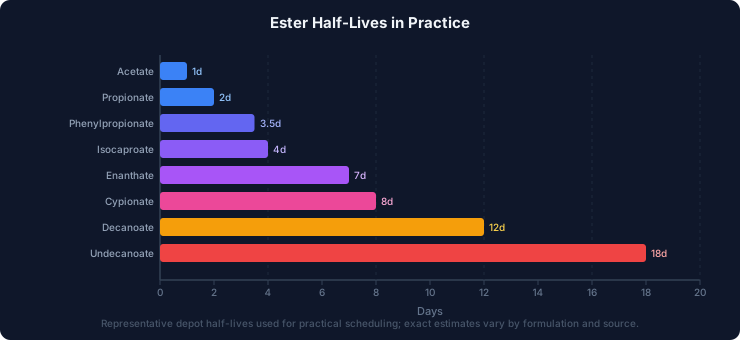
Propionate
The Propionate ester is a 3-carbon chain that confers a half-life of approximately 2 days (roughly 48 hours) in oil-based injection solutions. This means blood levels peak and fall rapidly, requiring injections every other day (EOD) or even daily (ED) to maintain stable concentrations. Testosterone Propionate was one of the earliest synthetic testosterone preparations and remains popular for its fast-acting nature: effects (both therapeutic and adverse) manifest sooner, and blood levels clear faster post-cessation, making it useful for pre-contest phases where a user wants to be off androgens within a week or two of competition.
The rapid half-life also means that dose adjustments have faster impact, and estradiol management may need more frequent recalibration. PIP (post-injection pain) is notably more common with Propionate-based solutions, partly due to the shorter-chain ester itself and partly because Propionate is often formulated in more irritating concentrations or solvents. Testosterone Propionate at 100 mg/mL typically delivers about 83 mg of active free testosterone per injection.
Phenylpropionate
Phenylpropionate is a slightly longer and more complex ester, with a half-life around 3–4 days. It is best known as the ester in Nandrolone Phenylpropionate (NPP), which became popular as a shorter-acting alternative to Nandrolone Decanoate for users wanting faster blood level saturation and clearance. NPP typically requires EOD or E3D dosing. The Phenylpropionate ester contributes about 33% of the molecular weight, meaning 100 mg of Nandrolone Phenylpropionate provides approximately 67 mg of free Nandrolone.
Enanthate
The Enanthate ester, a 7-carbon chain, produces a half-life of approximately 7 days (168 hours) for testosterone-based preparations. It is among the most widely used esters globally and forms the basis for Testosterone Enanthate, one of the most prescribed forms of TRT. At a 7-day half-life, twice-per-week injections maintain relatively stable blood levels, and once-weekly injections are clinically acceptable for TRT with modestly greater peak-trough variation.
The Enanthate ester represents approximately 28% of the total molecular weight, yielding an active compound fraction of about 72% by weight. So 500 mg/week of Testosterone Enanthate provides approximately 360 mg of active testosterone per week. This calculation, multiplying the labelled dose by the active fraction, is important when comparing protocols across different esters.
Cypionate
Testosterone Cypionate is almost interchangeable with Testosterone Enanthate in clinical practice, with a half-life of approximately 8 days (192 hours). Cypionate is the dominant TRT preparation in the United States (where it is more widely manufactured), while Enanthate is more common in Europe and much of the world. The Cypionate ester accounts for about 30% of molecular weight, yielding an active fraction of roughly 70%. Enanthate and Cypionate are dose-substitutable on a 1:1 basis with no meaningful pharmacokinetic difference.
Decanoate
The Decanoate ester is a 10-carbon chain with a half-life in the range of 7–14 days depending on the oil vehicle and formulation. It is best known as the ester in Nandrolone Decanoate (Deca-Durabolin), historically one of the most commonly prescribed anabolic steroids globally. The long half-life of Decanoate means that blood levels rise slowly over the first several weeks and fall slowly after cessation. For Nandrolone Decanoate, full clearance after the last injection takes approximately 5–6 weeks, which has significant implications for PCT timing, PCT cannot begin effectively until Nandrolone levels have cleared sufficiently to allow HPTA restart.
The Decanoate ester represents approximately 36% of molecular weight, so an active fraction of about 64% applies. Weekly or once-every-10-days dosing is typical for Decanoate preparations.
Undecanoate
The Undecanoate ester, used in Testosterone Undecanoate (Aveed, Nebido) and oral formulations (Andriol), has extremely long half-life characteristics in the injectable form, with levels measurable weeks after injection. Injectable Testosterone Undecanoate is typically dosed once every 10–14 weeks in TRT protocols. Its practical use in performance settings is limited because the very slow rise and fall of blood levels makes management of estradiol and other variables difficult.
Undecylenate
The Undecylenate ester is essentially unique to Equipoise (Boldenone Undecylenate), with a half-life of approximately 14 days. This extended half-life means Equipoise takes many weeks to reach steady-state saturation and falls slowly post-cycle. Once-weekly dosing is adequate for stable blood levels, but users sometimes opt for twice-weekly to reduce peak-trough variation.
Half-Life, Steady State, and Injection Frequency
The half-life of a compound is the time required for the concentration in blood to fall by 50% after a single dose. It takes approximately five half-lifes to reach steady-state concentration under a consistent dosing regimen, and the same five half-lifes to reach 97% clearance after the final dose.
For practical dosing, the implications are direct:
- A compound with a 2-day half-life (Propionate) needs ED or EOD dosing to avoid significant peaks and troughs.
- A compound with a 7-day half-life (Enanthate) reaches saturation after about 4–5 weeks of consistent twice-weekly injections. Blood levels drawn before this point do not accurately represent stable cycle levels.
- A compound with a 14-day half-life (Undecylenate, Decanoate) may not reach true steady state for 8–10 weeks.
The concept of saturation, the time to reach stable blood levels, matters for several practical reasons. Waiting for saturation before judging a compound’s effects or side effect profile avoids premature dose adjustments. Bloodwork drawn before saturation will not accurately represent on-cycle levels. And understanding the time to clearance post-final injection is essential for timing PCT correctly: you generally want the majority of active compound to have cleared before starting a SERM-based PCT, which means waiting 2 half-lifes after the last injection (at minimum) before beginning PCT for long-ester compounds.
Frontloading
Frontloading is a dosing strategy in which the first injection (or first week) uses a dose roughly twice the standard weekly amount, with the purpose of accelerating the time to steady-state blood levels. Instead of waiting 4–5 weeks for a long-ester compound to reach saturation, a frontload achieves near-steady-state concentration within the first week.
The pharmacokinetic rationale is sound: by depositing a large bolus that approximates the total body steady-state load immediately, the compound reaches therapeutic levels faster. The tradeoff is that estradiol and other side effects can spike dramatically in the first week, requiring rapid AI calibration and careful monitoring. Frontloading is most commonly discussed in the context of Testosterone Enanthate or Cypionate, where the standard approach is to inject double the intended weekly dose (split into two administrations) in the first week.
Reading Concentrations and Calculating Doses
Injectables are typically supplied as oil solutions measured in mg/mL (milligrams of esterified compound per millilitre of solution). Common concentrations are 100 mg/mL, 200 mg/mL, and 250 mg/mL for testosterone preparations; Trenbolone Acetate is frequently seen at 100 mg/mL; Equipoise at 200–300 mg/mL.
Calculating an injection volume from a target dose is simple arithmetic:
Volume (mL) = Target dose (mg) ÷ Concentration (mg/mL)
For example: to inject 250 mg from a 250 mg/mL solution, you draw 1.0 mL. For 375 mg from a 250 mg/mL solution, you draw 1.5 mL.
To calculate the active compound delivered, accounting for ester weight, multiply by the active fraction:
Active compound (mg) = Injected mg × Active fraction
For Testosterone Enanthate: 250 mg × 0.72 = approximately 180 mg of free testosterone. For Nandrolone Decanoate: 400 mg × 0.64 = approximately 256 mg of free Nandrolone.
This calculation becomes important when constructing protocols that specify active compound doses rather than labelled ester doses, a distinction worth being explicit about when reading protocol information, since different sources use the two conventions interchangeably in ways that create significant dose confusion.
Selected references for major clinical, mechanistic, or protocol claims. Community-practice points may not be cited individually.