The Philosophy and Practice of Harm Reduction
What harm reduction really means for PED users, how to stratify risk honestly, and the non-negotiables before any cycle.
- Understand what harm reduction means and why it applies to PED use
- Recognize how risk varies by compound, dose, duration, and individual health status
- Know the role of bloodwork and informed consent in responsible use
- Identify absolute contraindications that make any use inadvisable
On this page
Harm Reduction in Practice
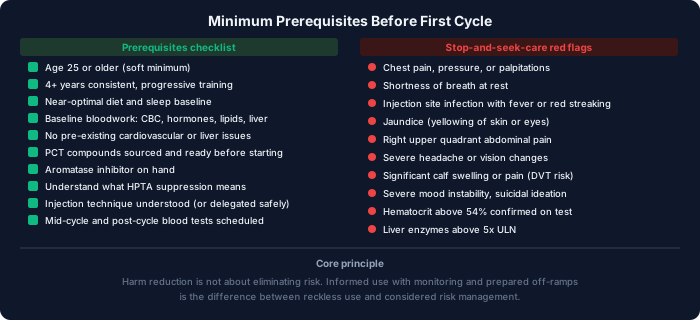
Harm reduction is not a euphemism for enabling reckless behaviour, nor is it a political stance on whether people should use performance-enhancing drugs. It is a pragmatic, evidence-based public health framework that acknowledges a simple truth: people will make choices that carry risk, and those choices can be made more or less safely depending on the quality of information available.
The harm reduction model arose from addiction medicine in the 1980s as practitioners recognised that abstinence-only messaging failed to reach most drug users, and that clean needles, naloxone distribution, and honest education saved lives even when they didn’t stop use entirely. Applied to the world of performance-enhancing compounds, anabolic steroids, peptides, SARMs, ancillaries, the same logic holds. Millions of people globally use these substances. The question is not merely whether to use them, but what the best available knowledge says about minimising the physiological cost.
CompoundLab exists inside this framework. The information here is not a recommendation to use any compound. It is an honest accounting of mechanisms, risks, monitoring protocols, and mitigation strategies, because an informed user who tests their blood, understands suppression, manages aromatization, and watches their lipids is categorically safer than one who does not.
Risk Is Not Binary
A foundational error in most public discourse about steroids is treating all use as equivalent. This is medically illiterate. A 35-year-old male with normal bloodwork, no cardiovascular risk factors, no family history of prostate cancer, running Testosterone Enanthate at 200 mg/week for 12 weeks with proper monitoring is occupying a vastly different risk category than a 19-year-old with hypertension injecting a stack of five compounds including Trenbolone, an oral 17-alpha-alkylated steroid, and unprescribed insulin sensitivity-modifying peptides.
Risk stratification means being honest about the variables that actually move the needle on harm:
Compound selection. Testosterone is the most well-studied androgen in human medicine, with decades of pharmacokinetic data and an established side-effect profile. Trenbolone has no approved human medical use, extremely potent androgenic activity, significant cardiovascular and neurological signals in the literature, and a much higher harm floor even at conservative doses. Anavar (oxandrolone), by contrast, has genuine pharmaceutical history in paediatric and wasting disease populations and carries a more modest risk profile at therapeutic doses. Compound selection alone can change risk by an order of magnitude.
Dose. The dose-response relationship for anabolic benefit is non-linear and hits diminishing returns, while the relationship for side effects is often linear or superlinear. Running Testosterone at 150 mg/week for TRT-range purposes is not the same physiological event as 1,500 mg/week. Most organ systems, cardiac, hepatic, haematological, scale with dose and duration in ways that compound-specific information cannot fully capture.
Duration. Time on cycle is an independent risk variable. Extended cycles cause prolonged suppression of the HPTA, greater cumulative exposure to supraphysiological hormone levels, and more time for adaptive remodelling in organs like the left ventricle. The concept of time on = time off exists precisely because recovery capacity is finite.
Age and developmental status. The endocrine system is not fully mature until the mid-twenties. Introducing exogenous androgens during this window suppresses endogenous LH and FSH signals at a time when those signals are actively sculpting receptor density, bone closure, and neurological organisation. The risk of permanent HPTA disruption, accelerated epiphyseal closure (with stunted final height in teenagers), and cascading hormonal effects is substantially elevated in users under 24–25. This is physiology, not moral judgment.
Individual health baseline. Pre-existing cardiovascular disease, hypertension, polycythaemia, elevated hematocrit, insulin resistance, sleep apnoea, prostate pathology, hepatic disease, psychiatric conditions, and a family history of early cardiac events all modify baseline risk in meaningful ways. Someone with any of these should approach the question of use with a specialist, not an internet forum.
Informed Consent and Personal Accountability
Informed consent, the medical principle that a person cannot agree to a procedure or intervention without understanding its nature, risks, alternatives, and consequences, is the foundation of ethical medical practice. When physicians prescribe testosterone replacement therapy, they walk the patient through known side effects before the first injection. The same principle should govern recreational use.
True informed consent for PED use requires:
-
Understanding the mechanism of action of every compound you use, not at a biochemical PhD level, but well enough to understand why Testosterone raises hematocrit, why 19-nor compounds like Nandrolone and Trenbolone carry prolactin risk, why hepatotoxic 17-alpha-alkylated orals stress the liver, and why aromatization is not automatically bad but needs management.
-
Baseline bloodwork before any first cycle. You cannot know what a compound is doing to your markers if you don’t know what those markers looked like before. Pre-cycle bloodwork establishes your personal normal ranges, a step that cannot be retroactively added.
-
A plan for monitoring during the cycle. What markers will you check and when? What values would prompt you to pause or stop? Having these thresholds in advance prevents the motivated reasoning that makes people dismiss warning signs mid-cycle.
-
A plan for what comes after. Whether that is a properly structured PCT protocol, a medically supervised cruise, or a return to baseline and full recovery, the post-cycle plan is not optional. The absence of a recovery plan is the most common source of lasting hormonal dysfunction in recreational users.
-
Honest self-assessment of readiness. Are you training seriously and consistently? Is your diet in order? Are you sleeping? Have you spent time studying compound profiles, interaction risks, and ancillary use? If the answer to these is no, the risk-benefit calculation shifts dramatically against use.
Personal accountability is the complement to informed consent. Nobody can monitor your health for you. No forum, no service, no AI can substitute for your own consistent engagement with your blood results, your body’s signals, and your long-term health trajectory. The platform exists to give you better information, the responsibility for acting on it is yours.
How to Use CompoundLab Responsibly
CompoundLab is a harm-reduction educational resource. It provides compound profiles, interaction analysis, ancillary guidance, bloodwork context, and structured learning content. It is not a prescription service, not a cycle recommendation engine, and not a substitute for a physician who can examine you, review your full history, and take legal and clinical responsibility for a treatment plan.
Use the platform to understand mechanisms, not to shortcut thinking. When a compound profile says a compound suppresses LH and FSH and causes HPTA shutdown, that is prompting you to research PCT and plan for recovery, not telling you the risk is acceptable at any dose. When interaction analysis flags a risk between two compounds, explore why: understanding the mechanism gives you far more durable knowledge than a simple red/green flag.
Treat every piece of information here as a starting point for your own research, not an endpoint. Cross-reference against peer-reviewed literature (PubMed), clinical pharmacology texts, and ideally a physician willing to engage in harm-reduction-informed dialogue. Some sports medicine doctors, endocrinologists, and hormone specialists will work with patients who use performance-enhancing compounds, finding one is worth the effort.
Absolute Contraindications: When No Use Is Advisable
Harm reduction has limits. There are health conditions where the risk floor of any exogenous androgen use is high enough that no harm-reduction protocol meaningfully addresses it, and where use should be considered medically inadvisable absent the direct supervision of a relevant specialist:
Active cardiovascular disease. This includes recent myocardial infarction, unstable angina, heart failure, severe hypertension uncontrolled by medication, or clinically significant LV hypertrophy. Exogenous androgens increase red blood cell mass (hematocrit), reduce HDL lipids, promote atherosclerosis, and add cardiac workload. In a compromised cardiovascular system, the margin for serious harm is thin.
Active or recent malignancy. Androgenic activity is a growth signal for androgen-sensitive cancers, including prostate cancer. Any personal history of prostate cancer or other androgen-sensitive malignancy is a hard contraindication. Elevated PSA without a diagnosis warrants specialist evaluation before any androgen use.
Severe hepatic disease. Hepatotoxic oral compounds (17-alpha-alkylated steroids like Dianabol, Anadrol, Winstrol) are absolutely contraindicated in liver disease. Even injectable compounds metabolise through the liver and can stress impaired hepatic function.
Severe polycythaemia. If baseline hematocrit is already elevated, adding androgens (which stimulate erythropoiesis) risks haematological events including stroke and pulmonary embolism.
Age under 25. As discussed, the developmental risk profile is categorically different below this threshold. The HPTA remains in active developmental flux, and suppression at this stage carries a meaningfully higher risk of permanent dysfunction.
Psychiatric conditions exacerbated by androgens. There is solid literature linking high-dose androgen use to aggression, mood dysregulation, and psychiatric symptom exacerbation, particularly in individuals with bipolar disorder, psychosis, or severe borderline personality disorder. The signal is real enough that use in these populations without psychiatric oversight is inadvisable.
Pregnancy or intended pregnancy (for female partners). Exogenous androgens in males do not directly harm female partners, but the fertility considerations are real: suppression of LH and FSH dramatically reduces sperm production. If conception is planned in the near term, cycle timing needs serious consideration.
Harm reduction is not a permission slip. It is a framework for making difficult decisions with better information. The foundational lesson of this entire track is that the quality of your decisions scales directly with the quality of your understanding, and that there is no shortcut past that equation.
Selected references for major clinical, mechanistic, or protocol claims. Community-practice points may not be cited individually.