Understanding Your Bloodwork
How to read the key blood markers affected by PED use, what deviations mean, and when to pause, stop, or seek medical care.
- Explain why baseline bloodwork is mandatory before any first cycle
- Identify the key blood panels relevant to PED use and what each measures
- Interpret common deviations in testosterone, estradiol, LH/FSH, hematocrit, lipids, and liver enzymes
- Know the thresholds and symptoms that warrant pausing a cycle or seeking medical care
On this page
Why Bloodwork Is the Foundation of Safe Use
If there is a single practice that separates informed PED users from uninformed ones, it is consistent, well-timed bloodwork. No amount of anecdote, no forum thread, no compound profile can tell you what is actually happening inside your body. Blood tests can. The markers change on cycle in ways that matter, some predictably, some idiosyncratically, and most of the serious long-term harms associated with anabolic compound use are either preventable or detectable early when bloodwork is done correctly.
The reason bloodwork is non-negotiable rather than merely advisable comes down to asymmetry: the cost of a comprehensive blood panel is low, the inconvenience is mild, and the information density is extremely high. Cardiovascular risk from chronically suppressed HDL lipids accumulates silently. Hematocrit creep into dangerous territory produces no dramatic symptoms until the risk of thrombotic event is already elevated. Hepatic enzyme elevation from a hepatotoxic oral can be addressed easily when caught at 2× normal and becomes a medical emergency when caught at 10×. Monitoring costs very little; ignoring it can cost a great deal.
The Three Bloodwork Windows
Effective monitoring requires bloodwork at three distinct phases, each serving a different function.
Pre-cycle (baseline). This is the most important draw you will ever do. It establishes your normal ranges, not laboratory reference ranges, which describe population averages, but your individual baseline before any exogenous intervention. Run this panel 4–6 weeks before your first cycle, when you have been off any performance-enhancing compounds (including OTC testosterone boosters and SARMs) for at least 8 weeks. Without a baseline, you can’t answer what a compound did to your markers, you can only observe a snapshot in isolation.
Mid-cycle (4–6 weeks in). For a cycle lasting 12–16 weeks, a mid-point draw catches problems while there is still time to intervene: adjust an AI dose, address hematocrit creep, identify an estradiol issue before it causes symptoms. The specific timing depends on compound half-lifes, you want to draw when levels have reached steady state, typically at least five half-lifes after beginning the new dose.
Post-cycle (4–6 weeks after cessation). This draw serves two purposes: confirming recovery of natural hormone production (rising LH, FSH, and endogenous total testosterone) and evaluating how well your body has returned toward baseline on lipids, hematocrit, and liver enzymes. It is also the moment to assess whether PCT was effective and whether any markers warrant follow-up investigation.
The Key Markers, Explained
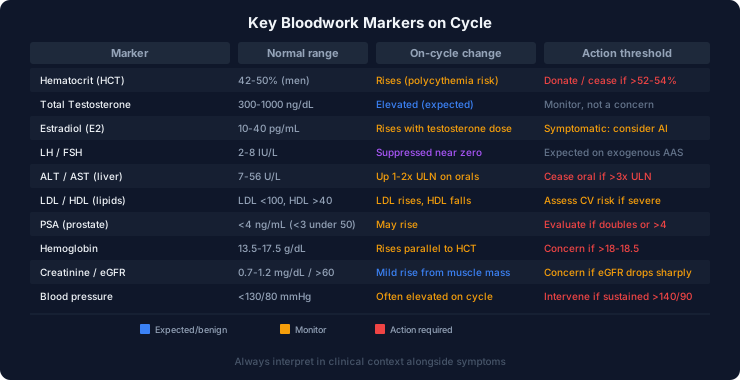
Total Testosterone and Free Testosterone
Total testosterone measures all testosterone in the blood, both the fraction bound to proteins (SHBG and albumin) and the unbound fraction. Free testosterone is the biologically active portion, representing roughly 2–3% of total in most healthy males. SHBG levels modulate how much of the total is actually available for receptor binding.
On cycle with exogenous androgens, total testosterone will typically be supraphysiological, this is expected and tells you the compound is active. What matters more on-cycle is whether the ratio of estradiol to testosterone is appropriately managed (discussed below). Post-cycle, total testosterone recovering toward your pre-cycle baseline is a key marker of HPTA recovery. A total testosterone that remains low 8–12 weeks after a cycle has ended, in the presence of low LH and FSH, indicates ongoing suppression and warrants attention.
Estradiol (E2)
Estradiol is the primary oestrogen in males and is produced primarily via aromatization, the enzymatic conversion of testosterone (and other androgens) to oestrogen by the aromatase enzyme, predominantly in adipose tissue. The reference range for males is typically 10–40 pg/mL, though the optimal range for mood, libido, joint health, and bone density is generally considered 20–35 pg/mL.
Elevated estradiol (above ~50–60 pg/mL) can cause water retention, mood instability, gynecomastia (gyno), and reduced libido. Suppressed estradiol (below ~10–15 pg/mL, often from over-aggressive AI use) causes joint pain, low libido, mood depression, impaired nitrogen retention, and disrupted lipid profiles. Both extremes are harmful; the goal is management to a healthy range, not elimination.
On a cycle with a high-aromatization compound like Testosterone or Dianabol, estradiol will rise substantially and AI use may be warranted. On compounds that do not aromatize significantly, Trenbolone, Winstrol, Masteron, Anavar, estrogen suppression from a poorly calibrated AI is a more common error than elevation.
LH and FSH
LH (Luteinizing Hormone) and FSH (Follicle-Stimulating Hormone) are the pituitary signals that tell the testes to produce testosterone and sperm, respectively. They are the output side of the HPTA. On any cycle of exogenous androgens, negative feedback to the hypothalamus and pituitary will suppress LH and FSH toward zero, this is normal and expected, and does not itself represent a problem during the cycle.
Post-cycle, recovering LH and FSH are the primary evidence of HPTA recovery. A LH value below 1.0 IU/L at 8–12 weeks post-cycle, when total testosterone remains low, indicates the HPTA has not yet restarted and warrants a more intensive evaluation. SERMs like Tamoxifen and Clomiphene are commonly used in PCT protocols precisely because they competitively block oestrogen receptors in the hypothalamus and pituitary, removing the negative feedback signal and allowing LH and FSH to rise.
Hematocrit and Hemoglobin
Hematocrit (Hct) is the percentage of blood volume occupied by red blood cells. Normal range in males is approximately 38–50%. Androgens stimulate erythropoiesis (red blood cell production) via EPO upregulation and direct effects on erythroid progenitors, making elevated hematocrit one of the most predictable and universal side effects of androgen use.
The clinical concern above 52–54% is significantly increased blood viscosity, which raises the risk of thrombotic events, deep vein thrombosis, pulmonary embolism, stroke, and myocardial infarction. Above 55%, the risk is considered clinically serious. At these levels, therapeutic phlebotomy (blood donation or medically guided blood removal) is the standard intervention.
Practical management: get hematocrit at baseline, mid-cycle, and post-cycle. Stay well hydrated, dehydration artificially elevates the reading. If hematocrit consistently trends above 52%, donate blood, adjust your dose, or shorten your cycle. Do not ignore it.
Lipids: HDL, LDL, and Triglycerides
Lipids, cholesterol and triglycerides, are among the most consistently impacted markers by androgen use, and the effects are almost universally adverse. Androgens reduce HDL (“good” cholesterol) and typically raise LDL (“bad” cholesterol), a combination that accelerates atherosclerotic progression.
The magnitude of lipid disruption varies considerably by compound and route of administration. Oral 17-alpha-alkylated steroids (hepatotoxic compounds like Dianabol, Anadrol, Winstrol, Anavar) have the most severe lipid impact, HDL can fall 30–50% from baseline. Injectable compounds have a more modest but still meaningful effect. Trenbolone is notable among injectables for its significant lipid suppression, likely related to its high androgenic potency and lack of aromatization (oestrogen has a protective role in lipid metabolism).
There are no pharmacological interventions that fully counteract androgen-induced lipid depression, but consistent cardiovascular exercise, high-dose fish oil (3–5g EPA+DHA/day), and adequate dietary fibre all modestly support HDL. The most effective strategy is limiting cycle duration, avoiding or minimising oral hepatotoxic compound use, and giving adequate off-cycle time for recovery.
Liver Enzymes: ALT, AST, and GGT
Liver enzymes, primarily ALT (alanine aminotransferase), AST (aspartate aminotransferase), and GGT (gamma-glutamyl transferase), are markers of hepatocellular stress and damage. Elevated levels indicate the liver is under stress; the degree of elevation and its trajectory matter.
Mild elevations (1–2× the upper limit of normal) are common with even moderate exercise and do not necessarily indicate hepatotoxic injury, ALT and AST are present in muscle as well as liver, and intense training can elevate them modestly. However, elevations above 3× normal, or any level combined with symptoms (jaundice, right upper quadrant pain, fatigue, dark urine), require immediate cessation of any hepatotoxic compound and medical evaluation.
Oral 17-alpha-alkylated steroids are the primary source of significant hepatic stress. Anadrol and Dianabol are among the most hepatotoxic at commonly used doses. Anavar is often described as hepatically mild, though this is dose-dependent, meaningful elevations can occur at doses above 80–100 mg/day. Turinabol, Halotestin, Winstrol, Superdrol, and Epistane all carry significant hepatotoxic potential. Injectable compounds do not carry the same hepatic risk profile and are metabolically processed differently.
Liver support compounds like TUDCA (tauroursodeoxycholic acid) and UDCA have genuine evidence for reducing hepatotoxic compound-induced enzyme elevation and cell death. TUDCA is worth using any time an oral 17-alpha-alkylated steroid is part of a protocol.
PSA (Prostate-Specific Antigen)
PSA is a marker of prostate activity. In men under 40, baseline PSA should typically be below 2.5 ng/mL; in men 40–50, below 3.5 ng/mL. Exogenous androgens stimulate prostate tissue and will typically raise PSA modestly, rises of 0.5–1.5 ng/mL above baseline are common on cycle. What matters is trajectory: a PSA that is rising rapidly, reaches very high absolute values, or is accompanied by urinary symptoms (difficulty urinating, weak stream, frequent urination) warrants urological evaluation.
Anyone with a family history of prostate cancer, baseline PSA above the age-adjusted threshold, or urinary symptoms at baseline should discuss the risk-benefit ratio of any androgen use with a urologist before proceeding.
Thyroid Panel
Thyroid function, TSH, free T3, and free T4, is not directly impacted by most anabolic androgens at moderate doses, but including it in the baseline is worthwhile for two reasons. First, undiagnosed hypothyroidism affects energy, recovery, body composition, and metabolism in ways that are easily misattributed to suboptimal cycle response. Second, growth hormone secretagogues like Ipamorelin, CJC-1295, and MK-677 can affect thyroid axis function over time, making a baseline relevant for users exploring that space.
Reading Your Results: Practical Interpretation
Laboratory reference ranges are population statistics, not personal optima. A total testosterone of 400 ng/dL is technically within range but represents a very different health picture for a 25-year-old than for a 65-year-old. Context matters: compare against your baseline, track trends over time, and weight markers differently based on which compounds you are using.
The most important interpretive habit is pattern recognition over multiple draws, not reacting to single values in isolation. A single mildly elevated liver enzyme after a hard training session is not a crisis. A persistently elevated liver enzyme that fails to return to baseline four weeks after stopping an oral is a signal worth investigating.
When to Pause, Stop, or Seek Medical Care
Pause and investigate: Estradiol persistently outside the 20–40 pg/mL range despite AI adjustment. Hematocrit above 52% and rising. Liver enzymes above 2× normal. PSA significantly elevated above personal baseline. Significant lipid disruption (HDL below 30 mg/dL).
Stop the cycle: Liver enzymes above 3× normal. Hematocrit above 55%. Any signs of cardiac symptoms (chest pain, arrhythmia, shortness of breath with exertion). Rapidly rising PSA with urinary symptoms. Severe psychiatric symptoms (depression, psychosis, suicidal ideation).
Seek medical care immediately: Chest pain, severe dyspnoea, or signs of stroke (facial drooping, arm weakness, speech difficulty). Jaundice, severe abdominal pain, or dark urine. Signs of DVT or pulmonary embolism (unilateral leg swelling, pleuritic chest pain, haemoptysis). Any symptom that feels serious should be evaluated as serious, the fact that you are on a cycle does not mean the symptom has an obvious explanation.
Selected references for major clinical, mechanistic, or protocol claims. Community-practice points may not be cited individually.