On-Cycle Bloodwork and Health Monitoring
A practical guide to what blood tests to run during a cycle, when to run them, how to interpret results in context, and how to manage the most common on-cycle health changes, hematocrit, lipids, liver enzymes, and blood pressure.
- Know what to test during a cycle and the correct timing for meaningful results
- Interpret supraphysiological testosterone levels in context on a cycle
- Understand hematocrit elevation, why it happens, when it is dangerous, and how to respond
- Recognise lipid changes that indicate serious cardiovascular concern
- Monitor blood pressure effectively and know the action thresholds
On this page
The Purpose of On-Cycle Monitoring
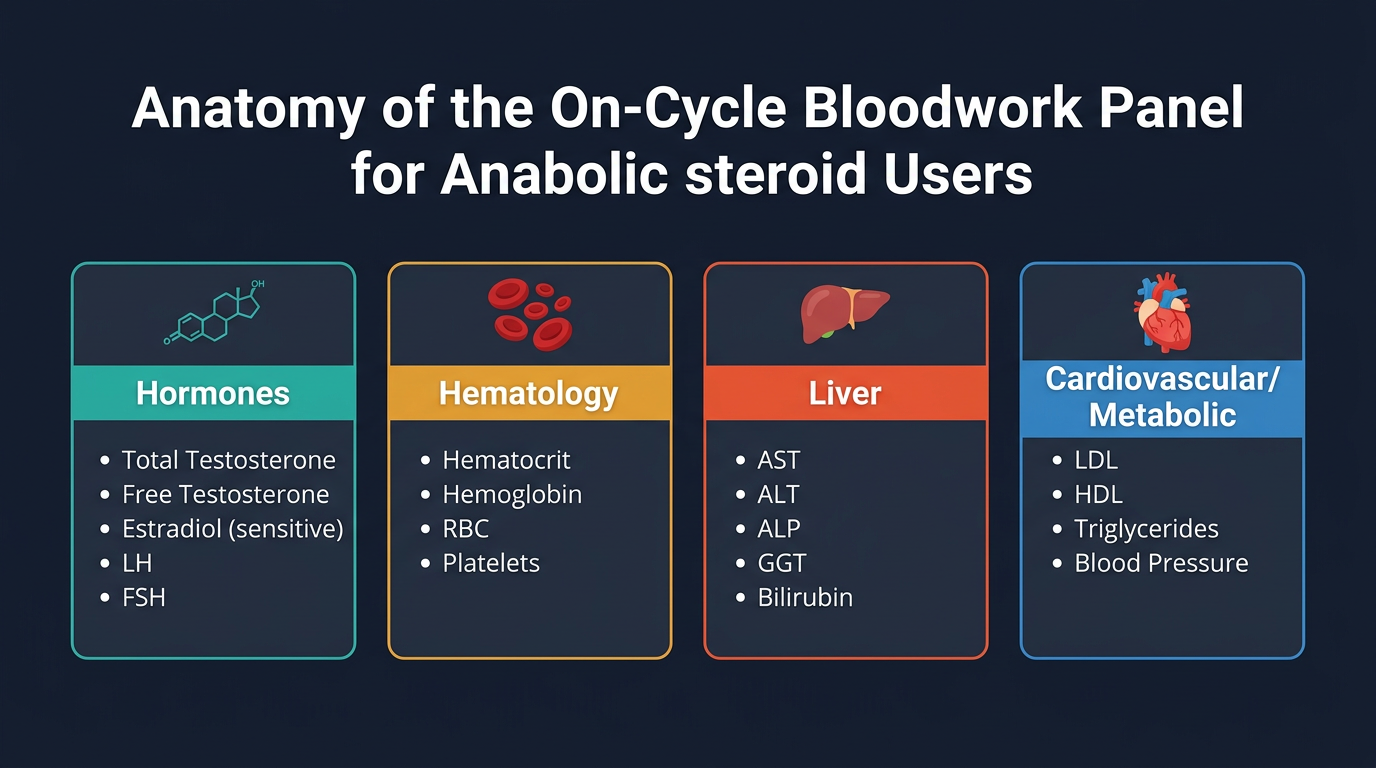
On-cycle bloodwork is not a formality or a safety theatre exercise. It is the only reliable way to detect the physiological changes that anabolic compounds produce in cardiovascular, hepatic, and hematological parameters, most of which have no consistent, reliable symptoms until they are severe. The man whose hematocrit has climbed to 54% may feel nothing unusual. The man with HDL at 18 mg/dL and rising LDL looks and feels fine in the gym. The man whose blood pressure is 148/95 across all readings may attribute his headaches to dehydration. These are not edge-case horror stories; they are common, measurable, modifiable changes that are detectable only through testing.
The logic of on-cycle monitoring is exactly the same as the logic for baseline testing: you cannot make informed decisions without data. The difference is that mid-cycle data is time-sensitive, it represents a window where you can still modify the protocol, add support compounds, address bloodwork findings, or make the decision to end the cycle early if the evidence warrants it.
When to Draw Blood: Timing Principles
The correct timing for mid-cycle bloodwork is a function of saturation pharmacokinetics. For long-ester Testosterone (Enanthate or Cypionate), saturation is reached at approximately week 4–5. Drawing bloodwork before this point shows artificially lower-than-representative testosterone and estradiol levels. Week 4–6 is the standard window for mid-cycle bloods, early enough to identify and address problems before they become entrenched, late enough that levels are stable and representative.
For the draw itself, optimal timing is at trough, just before a scheduled injection. This captures the lowest point of blood level variation across the dosing cycle, which provides the most conservative read on parameters like hematocrit (which rises with sustained high androgen exposure over time) and the most interpretable estradiol reading for AI management decisions.
If your cycle includes any oral hepatotoxic compounds, Dianabol, Anadrol, Winstrol, Anavar, Turinabol, draw blood at approximately week 3–4 of oral compound use rather than waiting until week 6. Liver enzyme changes from oral 17-alpha-alkylated steroids can escalate rapidly, and catching them at 2× the upper limit of normal (ULN) is far more manageable than discovering them at 5× ULN.
Fast for 8–10 hours before the draw for accurate lipid and glucose data.
Testosterone Levels on Cycle: What They Mean
A mid-cycle total testosterone result will show a number that, against standard reference ranges printed on the lab report, looks alarming, 2,000, 3,500, 5,000 ng/dL where the normal range is 300–1,000. This is expected, intended, and not a problem in itself. The purpose of drawing testosterone mid-cycle is not to verify it is in the normal range, it is to confirm that the compound you are using is active and to give a rough benchmark for cross-referencing with estradiol and other parameters.
Free testosterone will be similarly elevated. SHBG typically falls on cycle as elevated androgens suppress sex hormone-binding globulin production, which further increases the free testosterone fraction beyond what total testosterone alone suggests. LH and FSH will be near zero, this is the expected and normal consequence of exogenous androgen use suppressing the HPTA through negative feedback. Zero LH and FSH during an active cycle is not a problem; it confirms suppression is occurring as expected.
What is useful about the testosterone number is its rough correlation with estradiol: if your total testosterone is 4,000 ng/dL and your estradiol is 28 pg/mL, you are a low aromatizer who likely does not need an AI. If your total testosterone is 2,500 ng/dL and your estradiol is 95 pg/mL, you are a high aromatizer who needs intervention. The ratio informs the AI calibration decision more than the absolute testosterone value.
Hematocrit: The Cardiovascular Risk You Can Measure
Hematocrit is the most clinically significant parameter to monitor on a testosterone cycle, and it is also one that produces no reliable symptoms until it is quite high. It measures the proportion of red blood cells in total blood volume, expressed as a percentage. Androgens stimulate erythropoiesis, red blood cell production, through upregulation of erythropoietin (EPO) and direct bone marrow effects. This means hematocrit will rise on virtually every meaningful testosterone cycle, and the rise is dose- and duration-dependent.
Normal male hematocrit sits in the range of 38–50%. On an active testosterone cycle, levels of 50–55% are common. The clinical concern is blood viscosity, as hematocrit rises, blood becomes meaningfully thicker and flows less easily through capillaries and small vessels. Above approximately 52%, viscosity increases start to have measurable cardiovascular implications. Above 55%, the risk of thromboembolic events (blood clots, stroke, pulmonary embolism) becomes clinically significant.
The management response at different levels is straightforward. Below 52%: monitor at next cycle draw, no intervention required. At 52–54%: consider lifestyle optimisation, optimal hydration, reducing alcohol (dehydration elevates viscosity), maintaining cardiovascular exercise, and donating blood if your donation history and local blood bank policies permit it. Above 54%: therapeutic phlebotomy is appropriate, either through blood donation if eligible or physician-ordered phlebotomy if not. Reducing cycle dose may be indicated. Above 56–57%: serious concern requiring urgent therapeutic phlebotomy, significant dose reduction, and evaluation of blood pressure and clotting parameters.
One practical consideration: Testosterone Enanthate and Cypionate at doses above 400 mg/week in a cycle extending beyond 12 weeks will reliably push most men’s hematocrit above 50%, and many above 52%. If you are planning a longer cycle at higher doses, you should plan for this outcome and know your options in advance.
Lipid Changes: Reading the Risk Signals
Lipids, specifically the ratio of HDL to LDL, are significantly affected by exogenous androgens, and the changes they produce are genuine cardiovascular risk factors. Most anabolic users focus on their on-cycle strength numbers while their HDL quietly drops by 25–40% from baseline. The elevation is clinically significant.
HDL plays a direct role in reverse cholesterol transport, removing cholesterol from arterial walls and carrying it to the liver for excretion. When HDL falls, this protective process is impaired. Simultaneously, many anabolic cycles produce modest LDL elevation. The combination of depressed HDL and elevated LDL produces an atherogenic lipid profile that is qualitatively similar to what is seen in men at elevated cardiovascular risk.
For injectable testosterone alone at moderate doses (300–500 mg/week), HDL typically falls 15–25% from baseline. For oral 17-alpha-alkylated compounds, Dianabol, Anadrol, Winstrol, Anavar, Turinabol, HDL depression is far more severe: 30–50% or more from baseline is common during active use. That is one of the strongest arguments against stacking orals onto a beginner testosterone cycle, beyond the added complexity.
Practical action thresholds: HDL at 30–40 mg/dL is elevated concern, optimise fish oil intake (3–5g EPA+DHA daily), ensure cardiovascular conditioning is maintained, reassess dose. Below 30 mg/dL is serious concern, consider whether the current compound selection is appropriate and pursue aggressive cardiovascular protection. LDL above 160–180 mg/dL merits discussion with a physician, especially if cumulative risk factors are present.
No supplement or dietary intervention fully reverses androgen-induced HDL suppression. Fish oil at high doses, sustained cardiovascular exercise, and dietary fibre have measurable but modest benefits. The most effective intervention is limiting the duration and dose of compounds that suppress HDL most severely.
Liver Enzymes: Relevant When Using Orals
For a beginner running testosterone-only, liver enzyme monitoring is lower priority than hematocrit and lipids, injectable testosterone does not produce significant hepatotoxic stress at standard doses. However, if you add any oral compound to your protocol, liver enzyme monitoring becomes essential.
The key markers are ALT (alanine aminotransferase) and AST (aspartate aminotransferase). ALT is more liver-specific; AST is also elevated by intense muscle damage, so drawing blood in a rested state (48 hours post heavy training) improves the signal-to-noise ratio for hepatic interpretation.
Typical mild elevations on oral 17-alpha-alkylated compounds: 1–2× ULN during active use. This is common and, in isolation, does not require cycle termination, but does warrant monitoring. Elevations above 3× ULN is significant hepatocellular stress and require cessation of the oral compound and retesting in 2–4 weeks. Above 5× ULN, or at any level accompanied by jaundice, right upper quadrant pain, or elevated bilirubin, requires immediate medical attention.
TUDCA (tauroursodeoxycholic acid) is the best-evidenced hepatoprotective supplement for use alongside hepatotoxic compounds. The standard dosing is 250–500 mg/day during oral compound use. It does not eliminate enzyme elevation but meaningfully reduces it in multiple studies. It is a reasonable baseline addition for any cycle that includes oral compounds.
Blood Pressure: Monitoring, Ranges, and Management
Blood pressure is a critical on-cycle health parameter that most beginners under-monitor because it requires a cuff and effort rather than a blood test. Anabolic cycles elevate blood pressure through multiple mechanisms: fluid volume expansion from estradiol-mediated water retention, elevated red blood cell mass from androgen-stimulated erythropoiesis, direct vascular effects of androgens, and any stimulant compound co-use.
Check blood pressure regularly throughout your cycle, ideally weekly, using a validated home cuff. Take readings in a rested, seated state, arm at heart height, after five minutes of sitting quietly. Take three readings two minutes apart and record the average. A single high reading is less meaningful than a trend.
Below 130/80 is normal, continue monitoring. A reading of 130–139/80–89 (Stage 1 hypertension) is elevated, address lifestyle inputs including sodium restriction, cardiovascular training, and AI adjustment if water retention is contributing. A level of 140–159/90–99 (Stage 2 hypertension) is a significant concern, if not responding to lifestyle intervention within 1–2 weeks, reduce dose. Above 160/100 persistently: cycle should be reconsidered and a physician consulted. This level of blood pressure elevation carries real stroke and cardiac event risk.
The lifestyle inputs with the most evidence for managing cycle-related blood pressure elevation: reducing dietary sodium, maintaining regular aerobic exercise (not just lifting), optimising estradiol management to reduce fluid volume, ensuring adequate hydration, and eliminating or reducing stimulant co-use.
Selected references for major clinical, mechanistic, or protocol claims. Community-practice points may not be cited individually.