Advanced Ancillary Management
Mechanistic analysis of AI selection, prolactin management, SHBG manipulation, liver support evidence, cardiovascular ancillaries, and the critical principle that over-reliance on ancillaries signals a stack that needs simplification.
- Select between Anastrozole and Exemestane based on mechanism, rebound risk, and individual response
- Manage prolactin elevation from 19-nor compounds with appropriate pharmacological tools
- Use Proviron strategically to manipulate the free androgen fraction via SHBG
- Evaluate the evidence base for liver support compounds and dose them correctly
- Recognise when ancillary complexity signals a stack that should be simplified
On this page
Choosing an AI: Anastrozole vs. Exemestane
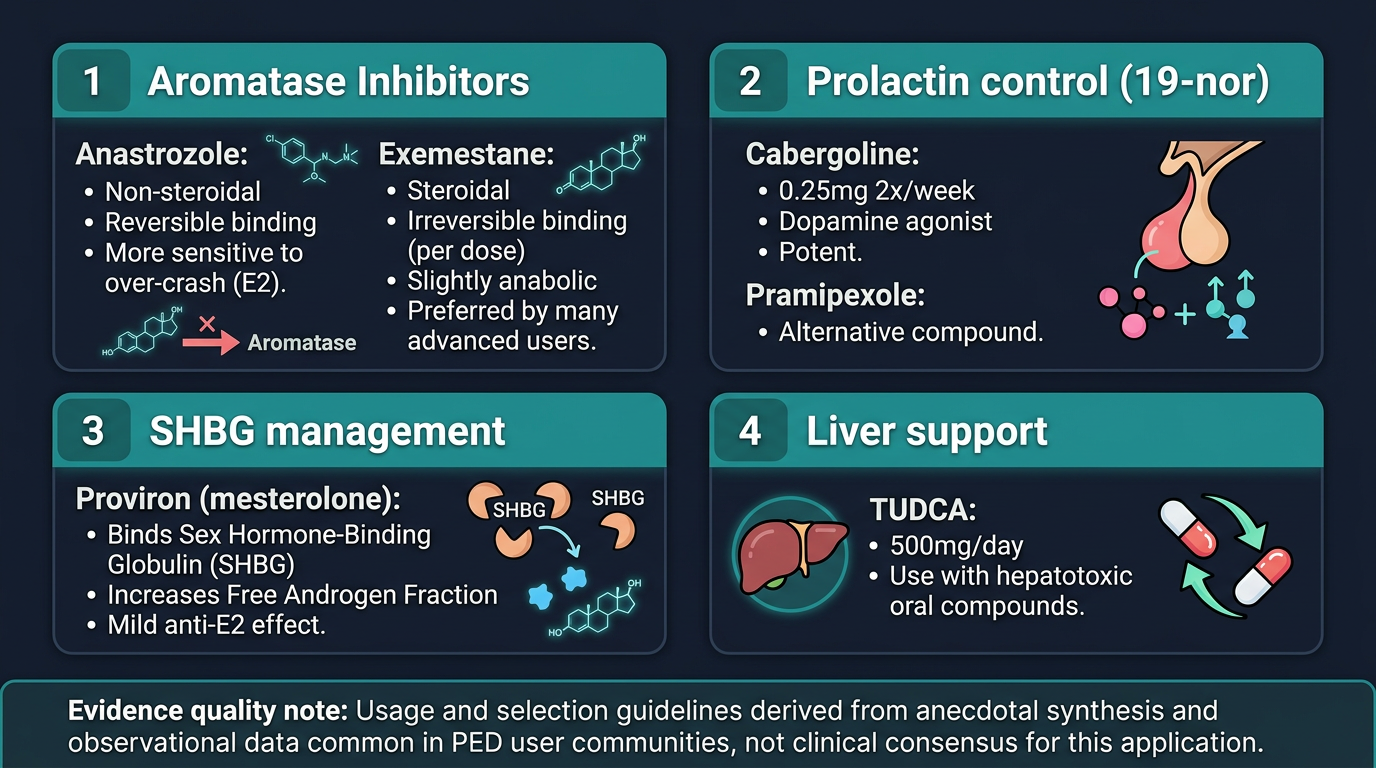
Both Arimidex (anastrozole) and Aromasin (exemestane) reduce estradiol by interfering with aromatase (CYP19A1), but the advanced question is not simply “which one is stronger?” The real question is what kind of control problem you are trying to solve. Are you dealing with a protocol that runs a little hot and needs gentle, reversible steering, or a protocol that produces repeated rebound, unstable peaks, and difficult-to-control estrogen dynamics?
Arimidex (anastrozole) is a non-steroidal AI. It binds to the active site of aromatase reversibly and competitively, it does not destroy the enzyme but occupies it, preventing androgen substrate from binding. When anastrozole is cleared from the body (its half-life is approximately 46 hours), the enzyme is released intact and returns to activity. That reversibility is exactly why some users like it and exactly why others get into trouble with it. It is easy to nudge up or down in small steps, but if the underlying testosterone peak is excessive, or if the lab was drawn at the wrong time relative to injection and AI dosing, a user can end up chasing swings rather than controlling them.
Aromasin (exemestane) is a steroidal AI, and it binds aromatase in a mechanism-based, irreversible fashion. Exemestane acts as a “suicide substrate”: aromatase processes it as if it were an androgen substrate, but in doing so, the enzyme forms a covalent bond with the drug that permanently inactivates it. New aromatase must be synthesised to restore enzyme activity. The practical result is a flatter rebound profile, but also less forgiveness if the user overshoots. When people say exemestane feels “smoother,” they usually mean exactly that: less abrupt reactivation of intact enzyme. When people say it can be harder to recover from a crash, they mean the same thing from the other side.
The more advanced distinction is about timing and interpretability. Anastrozole is often easier when you want to make fine adjustments around a changing testosterone dose. Exemestane is often easier when the user is reacting badly to rebound dynamics or when AI decisions are being made over a longer window rather than every few days. Neither decision should be made from symptoms alone. Blood draw timing relative to both the testosterone injection and the AI dose changes what the result means. An estradiol drawn near testosterone peak after recent anastrozole use tells you something very different from a trough draw taken several days after the last AI dose.
Neither AI is categorically superior. Both can crash estradiol if overdosed, and crashed estradiol is often more damaging in the short term than moderately elevated estradiol. Joint pain, low libido, depressed mood, impaired erection quality, and disrupted lipids all follow. This is also why an advanced user should stop thinking of estradiol control as “dryness management.” Estradiol is part of bone, brain, vascular, and sexual function. The target is functional stability, not the flattest possible look.
Prolactin Management: The 19-Nor Problem
Prolactin elevation with 19-nor compound use is a genuinely distinct management problem from estradiol elevation, and confusing the two is a common clinical error. The mechanism by which Nandrolone and Trenbolone raise prolactin likely involves multiple pathways: direct progesterone-receptor signaling, altered hypothalamic dopaminergic tone, and the fact that progesterone and estrogen signaling interact in breast tissue. Advanced management therefore starts with a simple rule: do not treat the lab in isolation, and do not treat the symptom as if it automatically tells you which hormone is at fault.
Cabergoline (a dopamine agonist at D2 receptors) is the standard intervention when prolactin is genuinely elevated and clinically relevant. It directly activates the same dopaminergic pathways that normally suppress prolactin, restoring inhibitory control. Typical dosing is 0.25 mg twice weekly, with escalation only if both symptoms and follow-up labs justify it. The advanced mistake is using cabergoline prophylactically because someone plans to run tren. That often turns a manageable uncertainty into an unnecessary dopaminergic drug exposure with its own side effects: nausea, orthostasis, impulse-control changes, mood disturbance in vulnerable users, and eventually a protocol that needs support drugs to manage the support drugs.
A critical clarification: Cabergoline manages elevated prolactin, it does not treat gynecomastia driven by estradiol or direct progesterone receptor activation in breast tissue. If a user on Nandrolone develops gyno, the mechanism may be prolactin-driven, estrogen-driven, progesterone-receptor-driven, or mixed. Advanced reasoning means not collapsing all of that into “19-nor gyno.” If estradiol is high, fix estrogen first. If prolactin is high with compatible symptoms, then cabergoline makes sense. If both are normal and symptoms persist, the protocol itself is the problem more often than the ancillary choice is.
It is also worth noting that Trenbolone does not aromatize and cannot directly raise estradiol, but users on trenbolone combined with testosterone will still have estradiol from testosterone aromatization, and the combination of trenbolone’s progestogenic activity with even physiological estrogen can be sufficient to trigger gyno in sensitive individuals.
SHBG Manipulation: Proviron and the Free Androgen Fraction
SHBG (sex hormone-binding globulin) is a transport protein synthesised primarily in the liver that binds testosterone and DHT with high affinity. Testosterone bound to SHBG is not meaningfully available at the receptor. Only free testosterone and albumin-bound testosterone contribute to tissue-level androgenic activity. That much is basic. The advanced part is understanding that lowering SHBG is not a free win. It can increase the active hormone fraction, but it can also make levels less buffered, less stable, and harder to interpret.
Mesterolone (Proviron) is a DHT derivative that is often used as an SHBG manipulation tool. It binds SHBG with higher affinity than testosterone itself, displacing some testosterone into the free fraction. On a fixed testosterone dose, adding Mesterolone at 25–75 mg/day can increase free testosterone without changing total testosterone much. That sounds attractive, but the advanced question is not “can I free more test?” It is “does raising the free fraction help this protocol more than it worsens androgenic sides, estrogen interpretation, and tissue exposure?”
That distinction matters because low SHBG is not universally good. A user whose SHBG is already crushed by androgens or oral compounds may have more volatile free hormone swings, more acne, more hair loss pressure, and worse symptom interpretation even though the total testosterone number looks impressive. In that setting, chasing still-lower SHBG can make the protocol less stable rather than more effective.
Anavar and Winstrol produce more aggressive SHBG suppression than Mesterolone, but they do so partly by suppressing hepatic SHBG synthesis rather than merely displacing bound testosterone. That means their “everything feels stronger” effect is not a clean bonus. It often reflects a higher free-androgen environment with higher side-effect liability across the whole stack. That is why SHBG manipulation belongs in advanced discussions about distribution and tolerance, not just in bro logic about making all the drugs “hit harder.”
Liver Support: TUDCA, Evidence, and Protocols
The evidence base for hepatoprotective compounds in the context of 17-alpha-alkylated steroid use is limited but sufficient to support targeted use of specific agents. The mechanism of oral steroid hepatotoxicity involves bile acid accumulation, oxidative stress, and mitochondrial dysfunction leading to hepatocyte apoptosis and inflammatory cascade activation.
TUDCA (tauroursodeoxycholic acid) is the best-evidenced agent for this application. TUDCA is an endogenous bile acid present at low concentrations in human bile and is conjugated from ursodeoxycholic acid in the gut. Its hepatoprotective mechanisms include mitochondrial stabilisation (it prevents the mitochondrial membrane permeability transition that initiates apoptosis), inhibition of endoplasmic reticulum stress pathways, and direct anti-apoptotic activity in hepatocytes. Clinical data from cholestatic liver enzymes disease and alcohol-related liver injury support these mechanisms, and extrapolation to 17-aa steroid hepatotoxicity is mechanistically reasonable. The typical dosing in harm-reduction applications is 250–500 mg/day during the oral compound cycle, divided into two doses. There is no strong clinical data supporting higher doses; the dose-response relationship beyond 500 mg/day is not established.
UDCA (ursodeoxycholic acid, the unconjugated precursor) is less expensive and more widely available than TUDCA but appears to have lower bioavailability in the relevant hepatocyte-protective pathways. TUDCA is the preferred form when both are available. NAC (N-acetylcysteine) has supporting evidence as an antioxidant hepatoprotectant and is often co-administered at 600 mg/day, providing complementary rather than redundant protection by addressing oxidative stress mechanisms rather than bile acid toxicity.
Milk thistle (silymarin) is frequently recommended in harm-reduction communities but has a considerably weaker evidence base than TUDCA for this specific application. The clinical trials supporting silymarin are mostly in chronic alcohol-related liver disease at high doses; extrapolation to acute 17-aa steroid-induced enzyme elevation is speculative. It should not replace TUDCA as the primary hepatoprotective agent.
Cardiovascular Ancillaries: Managing the Lipid and Blood Pressure Problem
The cardiovascular effects of anabolic compound use, HDL depression, LDL elevation, hematocrit rise, blood pressure elevation, and long-term cardiac remodeling, cannot be fully mitigated pharmacologically. That needs to be said clearly because advanced users often treat ancillaries as if they can erase the biology of the base stack. They cannot. At best, they change slope, not category.
This is where evidence strength matters. High-dose fish oil (EPA and DHA) has real utility for triglycerides and modest anti-inflammatory support. It is not a serious rescue tool for ApoB-heavy, oral-driven dyslipidemia. Bergamot has interesting but much lighter data and belongs in the “maybe helpful” bucket, not in the same bucket as actual lipid-lowering medications. If ApoB is materially elevated, the advanced conversation is not really about supplements anymore, it is about whether the stack should be changed and whether medical lipid management like ezetimibe or a statin is now the more honest tool.
Blood pressure management remains the highest-value ancillary domain because blood pressure is the most direct chronic mechanical stressor in the whole cardiovascular picture. Lifestyle first: hydration, sodium control, body-fat control, sleep-apnea management, and regular cardiovascular exercise. If pharmacological management is required, telmisartan is often chosen because it is an effective ARB with clean once-daily use and some favorable metabolic reputation. But its main value is still blood-pressure control. Once users start talking about telmisartan mainly as a performance-adjacent “health bonus,” they are usually drifting away from the point.
The Ancillary Complexity Signal: When Management Becomes the Problem
An advanced practitioner recognises a specific pattern in stack evolution: the ancillary list grows longer and more complex as the compound list grows longer and more complex, and at some point the protocol is no longer optimised for performance, it is optimised for managing the side effects of the previous optimisation. A user running six compounds with eight ancillaries to manage resulting side effects has not constructed an advanced protocol; they have constructed a pharmacological house of cards.
The principle is simple: if managing the side effects of your current stack requires more pharmacological intervention than you are comfortable with, the stack is too complex. The correct response is not to add another ancillary, it is to identify which compound is generating the most side effect burden and remove or reduce it. Trenbolone is the canonical example: it is extraordinarily effective and produces an extraordinary side effect burden (cardiovascular, neurological, prolactin, blood pressure, night sweats, insomnia). The users who benefit from trenbolone are those who run it at the minimum effective dose for a limited duration, not those who run it continuously at escalating doses managed with an expanding ancillary list. The ancillary list is a diagnostic tool: its length tells you directly how far outside your manageable pharmacological range your current stack has extended.
Selected references for major clinical, mechanistic, or protocol claims. Community-practice points may not be cited individually.