SARMs, Prohormones, and Novel Compounds
What SARMs actually are mechanistically, the evidence and suppression profiles of LGD-4033, RAD-140, and Ostarine, why SARMs still require PCT consideration, the reality of prohormone conversion pathways, and the quality control and regulatory landscape for research chemicals.
- Explain the mechanistic basis for SARM tissue selectivity and its limitations in practice
- Compare the evidence base, dosing, and side-effect profiles of LGD-4033, RAD-140, and Ostarine
- Explain why SARMs suppress the HPTA and require PCT consideration
- Evaluate prohormone conversion pathways and the risk-to-reward ratio of currently available prohormones
- Understand the quality control problem with research chemicals and contamination risk
- Apply accurate regulatory and safety reasoning to novel compound evaluation
On this page
SARMs and Tissue Selectivity
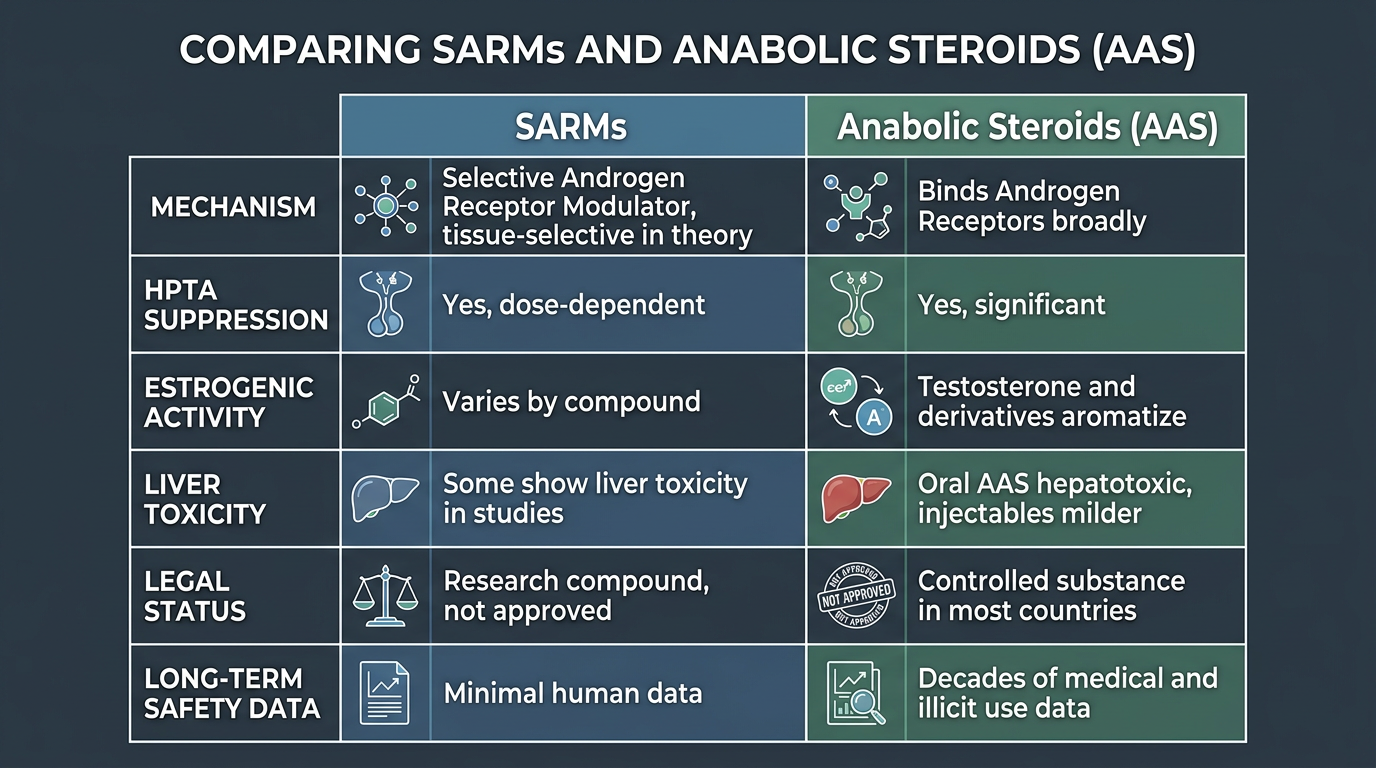
SARMs, selective androgen receptor modulators, were developed by pharmaceutical researchers beginning in the 1990s with a specific clinical goal: create androgen receptor agonists that produce anabolic effects in bone and muscle while avoiding androgenic effects in prostate, liver, and skin. The underlying hypothesis was that structural ligand properties could be tuned to stabilise specific AR conformations that recruit different coactivator protein complexes in different tissues, thereby producing tissue-selective transcriptional outputs from the same receptor.
The scientific concept is sound. Coactivator expression does vary by tissue, and different ligand conformations do recruit different coactivators. The problem is that the degree of selectivity achieved by available SARMs in human beings at doses required for meaningful anabolic effect is substantially less than early preclinical data suggested. Tissue selectivity is not binary, it is a continuum, and every SARM currently in use trades off some degree of the anabolic efficacy that makes the compound worthwhile against the androgenic selectivity that was the original design goal.
The most accurate way to think about SARMs in practice is as partial androgen receptor agonists with variable tissue selectivity ratios. They are not “steroids without side effects”, they are compounds with a different side effect profile than classical androgens, with the magnitude of both benefit and risk scaling with dose and duration. At low doses used clinically for muscle wasting, the selectivity ratio is relatively favourable. At higher doses used by athletes seeking significant performance enhancement, the selectivity ratio is considerably less impressive and the HPTA suppression is clinically significant.
LGD-4033 (Ligandrol): Evidence, Suppression, and Clinical Profile
LGD-4033 (ligandrol) is among the most potent SARMs by muscle anabolic effect and is the one with the most human clinical data published. The pivotal Phase I trial by Basaria et al. (2013) enrolled 76 healthy young men and randomised them to placebo or one of several doses of LGD-4033 (0.1 mg, 0.3 mg, or 1.0 mg/day). Dose-dependent lean mass gains were observed (approximately 1.2 kg at 1.0 mg/day over 21 days), along with dose-dependent LH and FSH suppression and dose-dependent testosterone suppression. The suppression was statistically and clinically significant even at the lowest dose.
This is the critical finding that is consistently minimised in performance community discourse: in a controlled trial at doses far below what athletes commonly use (1 mg vs. the typical athlete dose of 5–20 mg/day), LGD-4033 produced clinically significant gonadotropin suppression within 21 days. At athlete doses and durations (8–12+ weeks at 5–20 mg/day), HPTA suppression is profound. Recovery post-discontinuation without PCT is slower than typically assumed, the suppressive potency of LGD-4033 at athlete doses is comparable to mild anabolic steroid cycles.
The clinical side effect profile from available data includes: HDL suppression (less severe than 17-aa oral steroids but present and dose-dependent), LH/FSH suppression, reduced total testosterone, and in some users, fatigue, mood changes, and reduced libido attributable to androgen suppression during and after the cycle. The androgenicity of LGD-4033 is considered low compared to classical androgens, scalp and prostate effects appear modest in the available data, but this relative selectivity does not extend to the HPTA, which is not a tissue where SARM selectivity operates.
RAD-140 (Testolone): Mechanism, Evidence, and Risk Profile
RAD-140 (testolone) is a SARM with a distinctively high anabolic:androgenic ratio in preclinical assays, muscle anabolism equivalent to testosterone at the receptor level, with substantially less androgenicity in prostate and other androgen-sensitive tissues in animal models. It was developed as a potential testosterone replacement therapy candidate without the prostate growth concerns of testosterone. It has higher receptor binding affinity than testosterone at the AR.
The human clinical data is essentially absent for RAD-140, it has not progressed through meaningful Phase II human trials for its primary indication, and the Phase I human safety data is not fully published. The pharmacological profile used by athletes is almost entirely extrapolated from preclinical data and anecdotal human reports. This absence of human clinical data means that dose-response relationships for both efficacy and safety in humans are entirely unknown from a controlled-trial standpoint.
What is known from the preclinical and anecdotal literature: RAD-140 at 10–20 mg/day produces meaningful lean mass gains in athletes, more HPTA suppression than Ostarine but perhaps less than LGD-4033 at equivalent anabolic doses, and in some users, neurological or mood side effects (aggression, anxiety, headaches) that may reflect the compound’s reported effects on brain androgen receptor activity, RAD-140 was originally noted to have neuroprotective properties in preclinical dementia research, suggesting non-trivial CNS AR activity. Whether this translates to adverse neurological effects at performance doses is unknown. HDL suppression with RAD-140 appears more pronounced than with Ostarine and is reported as significant in anecdotal user data.
Ostarine (MK-2866): The Closest to a Studied SARM
Ostarine has the most extensive human clinical evidence of any SARM in this category, having completed multiple Phase II trials for muscle wasting indications. The most relevant trial for performance context is a randomised, dose-escalation study in cancer patients and healthy elderly subjects showing lean mass preservation and improvements at doses of 1–3 mg/day, far below athlete doses of 15–25 mg/day.
Ostarine is generally considered the mildest SARM from an HPTA suppression standpoint at lower doses (10–15 mg/day), though the dose-dependence is steep: at 25 mg/day for 8 weeks, measurable testosterone suppression is documented in the published clinical literature. The androgenicity is low, minimal documented prostate, scalp, or skin effects at typical doses, consistent with the tissue-selectivity hypothesis at this dose range.
The clinical profile makes Ostarine relatively appropriate for: recovery phases where injury prevention and mild anabolic support are desired without full cycle suppression, older users managing sarcopenia who are not candidates for testosterone therapy, and experimental use in females where the low androgenicity profile is meaningful. The anabolic effect at doses that preserve relative HPTA function (10–15 mg/day) is modest, roughly equivalent to low-dose testosterone for lean mass support, without the estrogenic effects.
Why SARMs Still Suppress the HPTA and Require PCT Consideration
The belief that SARMs do not suppress the HPTA or do not require PCT is one of the most persistent and dangerous myths in the performance pharmacology community. The mechanism by which SARMs suppress the HPTA is identical to the mechanism by which classical androgens suppress it: exogenous androgen receptor agonism raises circulating androgen-equivalent signaling, which is detected by the hypothalamus and pituitary as a reason to reduce endogenous LH and FSH output, reducing testicular testosterone and sperm production.
The degree of HPTA suppression varies by SARM (more potent SARMs suppress more) and by dose (higher doses suppress more) but the direction is invariable, all SARMs at meaningful doses suppress the HPTA in proportion to their AR agonist potency. LGD-4033 at 10 mg/day for 12 weeks produces HPTA suppression comparable to a mild testosterone cycle. RAD-140 at 15–20 mg/day for 12 weeks produces HPTA suppression that in anecdotal reports takes 6–12 weeks to recover from without PCT.
The practical implication: any SARM cycle of meaningful dose and duration should be followed by a PCT protocol, typically Tamoxifen (Nolvadex) at 20–40 mg/day for 4–6 weeks, or Clomiphene at 25–50 mg/day for the same duration. The decision not to run PCT after a SARM cycle is based on the incorrect belief that SARMs do not suppress, once that belief is updated with the actual clinical data, the PCT rationale is the same as for any androgen cycle. Users who consistently run SARM cycles without PCT and experience prolonged recovery periods, fatigue, mood disruption, and low libido post-cycle are experiencing exactly what the clinical data predicts.
Prohormones: Conversion Pathways and the Reality of Risk-Reward
Prohormones are compounds that are themselves not pharmacologically active androgens but are converted in vivo by enzymatic pathways to active androgens. The original prohormone era (1990s–2000s) included androstenedione and androstenediol, compounds that convert to testosterone via aromatase and 3-beta-hydroxysteroid dehydrogenase pathways. These were sold as dietary supplements and are now mostly scheduled. The subsequent wave of designer prohormones (2000s–2010s) used structural modifications to create compounds that converted to steroids not yet scheduled at the time of their release, with Superdrol, Epistane, and Halodrol among the most prominent.
The key pharmacological point about prohormone conversion: conversion efficiency varies enormously by individual, is influenced by enzyme activity and competition from other substrates, and cannot be reliably predicted from the prohormone dose. A user who converts 20% of their prohormone to active androgen and another who converts 5% will have dramatically different exposures from the same dose. This unpredictability makes dose titration difficult and safety assessment unreliable.
The currently available prohormone market, post-2014 Designer Steroid Control Act in the US, contains compounds either not yet scheduled or sold in grey-market jurisdictions. Most are not prohormones in the true sense but are themselves active androgens marketed with sufficient structural novelty to avoid scheduling. Epistane and Superdrol remain available as research chemicals and have known pharmacological profiles from their designer prohormone era, both are active 17-aa methyl steroids with hepatotoxic profiles comparable to the controlled oral steroids they structurally resemble. The risk profile is essentially identical to scheduled oral steroids, with the additional risk that regulatory oversight for product quality does not apply.
Research Chemicals: The Quality Control Crisis
The most underappreciated risk in the SARM and novel compound space is the quality control catastrophe of the research chemical industry. SARMs are not regulated as pharmaceuticals, dietary supplements with label accuracy requirements, or schedule-controlled substances with law enforcement supply chain accountability. They are manufactured and distributed as research chemicals, a legal designation that carries essentially no quality control obligations in most jurisdictions.
Third-party analytical testing of commercially available SARM products, conducted by academic researchers and independent laboratories, has found: products with significantly more or less active compound than labelled (deviations of 50–200% from label are documented); products contaminated with other SARMs not on the label; products containing banned substances not listed on the label; products that contain no active compound whatsoever; and products containing unknown organic compounds at levels that may have pharmacological activity.
The problem extends well beyond obviously low-quality sources. Multiple analyses have found label inaccuracy and contamination in products from suppliers with professional websites, extensive community trust, and premium pricing. The absence of pharmaceutical-grade manufacturing standards, third-party certificate of analysis requirements with chain of custody, and regulatory oversight means there is no reliable mechanism to ensure that a SARM product contains what it claims.
The practical implication for users: third-party HPLC/MS testing of specific product batches (services are available from analytical chemistry labs and can be ordered independently) is the only way to have reasonable confidence in product identity and purity. Community-trusted sources with published, verified third-party testing for specific batch numbers are more reliable than untested sources regardless of price or reputation.
The Regulatory Landscape: Why Legal Does Not Mean Safe or Studied
The regulatory status of a compound, whether it is scheduled, not scheduled, sold legally in a given jurisdiction, or designated as a research chemical, provides no information about its safety profile or the extent to which its human pharmacology has been characterised.
LGD-4033, RAD-140, Ostarine, Andarine, S-23, YK-11, LGD-3303, and ACP-105 are all currently sold legally in many jurisdictions as research chemicals. None are approved for human use by any major regulatory authority. The human safety data for most of them extends to small Phase I trials (in the case of Ostarine and LGD-4033) or essentially nothing (in the case of YK-11, S-23, ACP-105). Legal in this context means only that the compound has not been explicitly prohibited, not that it has been reviewed for safety, not that its long-term effects are known, and not that its dose-response relationship in humans has been characterised.
YK-11 is particularly illustrative: it is widely discussed in performance communities as a myostatin inhibitor SARM, a claim based on a single in vitro cell culture study showing that YK-11 reduced myostatin expression in muscle cells. There is no human data on YK-11. Its structural characteristics suggest it may behave as a partial AR agonist with some steroidal properties (it is a derivative of 19-nor DHT), but the pharmacokinetics, bioavailability, receptor selectivity in vivo, and safety profile in humans are entirely unknown. Users who take YK-11 for its purported myostatin inhibition are making pharmacological decisions based on a single cell culture observation, without any human data to support dose selection, duration, or expected effects.
The responsible epistemic framework is to distinguish clearly between: compounds with controlled clinical trial data in humans (Ostarine, LGD-4033 to a limited extent); compounds with preclinical data but no meaningful human data (most other SARMs); and compounds where even preclinical data is sparse or absent. Risk acceptance should scale inversely with the quality of available evidence, and the performance community has systematically inverted this relationship, embracing the most novel and least-studied compounds with the most confidence.
Selected references for major clinical, mechanistic, or protocol claims. Community-practice points may not be cited individually.