Stack Design: Logic, Synergies, and the Principle of Least Complexity
A systematic framework for building compound stacks, the testosterone base rationale, synergy vs. redundancy, bulking and cutting architectures, managing androgenic load, and why more compounds reliably produce more problems rather than more gains.
- Articulate the pharmacological basis for using testosterone as a stack base
- Distinguish additive synergy from pharmacological redundancy in compound selection
- Design rational bulking and cutting stacks with logical compound pairing
- Calculate androgenic load across a multi-compound protocol
- Apply the principle of least complexity to evaluate whether a stack should be simplified
On this page
Why Testosterone Is the Base Compound: The Pharmacological Argument
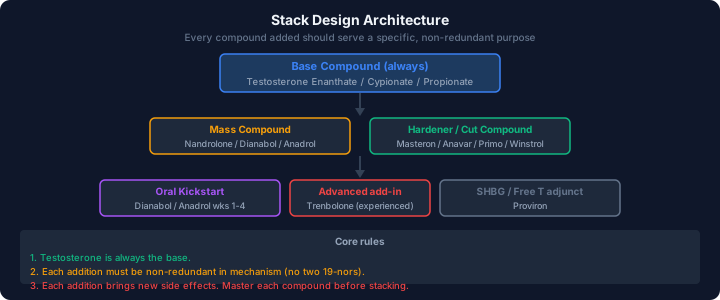
The near-universal recommendation to use Testosterone as the base of any anabolic stack is grounded in mechanistic rationale, not convention. Testosterone is the endogenous androgen around which male physiology is calibrated. Exogenous androgens, including all the compounds discussed in this track, suppress endogenous Testosterone production via negative feedback on the HPTA in a dose-dependent and compound-dependent manner. At any meaningful anabolic dose of any compound, LH and FSH will be suppressed, and endogenous testosterone production will be reduced or eliminated.
This creates a physiological deficit. [Testosterone] performs functions in the male body that no other androgen fully replicates: it supports libido and erectile function through central AR mechanisms, provides the estrogen substrate for estradiol production via aromatization, maintains bone mineral density through combined androgen and estrogen receptor activity, and supports cardiovascular function through multiple pathways. When exogenous Testosterone is not included in a stack, the user relies entirely on other exogenous androgens to satisfy these physiological roles, and most do not. Trenbolone does not aromatize, so running trenbolone without testosterone produces a zero-estrogen environment that devastates libido, joint health, cardiovascular markers, and mood. Nandrolone without testosterone is the classic “deca dick” scenario, nandrolone’s progestogenic activity suppresses dopaminergic pathways involved in sexual function, and without the countervailing testosterone-to-estradiol conversion providing estrogenic support, sexual dysfunction becomes severe.
The minimum effective testosterone dose in a stack is a subject of genuine debate. TRT-dose or cruise testosterone, typically 100–200 mg/week, is sufficient to maintain physiological function without meaningfully contributing to estrogen load or androgenic sides, allowing other compounds to be the primary anabolic drivers. Higher testosterone doses (300–500 mg/week or beyond) shift testosterone from a supportive role to a primary anabolic driver, changing the stack’s character and often requiring more active AI management. Understanding this distinction allows rational dose selection: run testosterone at the dose appropriate to its intended role in the specific stack.
Synergy vs. Redundancy: The Core Stack Design Principle
Pharmacological synergy in the context of anabolic stacking means combining compounds that produce additive or supraadditive effects through distinct, complementary mechanisms. Redundancy means combining compounds that activate the same pathways, produce the same types of effects, and compete for the same receptor populations, adding side effects and complexity without proportional benefit.
The clearest example of genuine synergy is the combination of an androgen operating via genomic AR mechanisms with a compound that provides non-AR anabolic pathways. Growth hormone and insulin act through growth hormone receptor and insulin receptor pathways respectively, upregulating IGF-1 production, enhancing protein synthesis via PI3K/Akt/mTOR signaling, and improving insulin sensitivity, mechanisms orthogonal to AR activation. Stacking exogenous androgens with GH-axis stimulation provides genuine additive anabolic effect because the pathways do not overlap. Within the androgen family itself, adding Nandrolone to Testosterone adds partial synergy: nandrolone’s very high nitrogen retention from its superior protein synthesis stimulation at low androgenic cost complements testosterone’s broader hormonal support role. The two compounds produce modestly supraadditive nitrogen retention because nandrolone is a more potent stimulator of nitrogen retention per unit of total androgenic exposure than testosterone alone.
Redundancy, by contrast, looks like running Trenbolone and Nandrolone simultaneously (both 19-nors competing for the same receptor populations and stacking progestogenic and prolactin-raising risk), running Dianabol and Anadrol simultaneously (both wet oral mass builders with overlapping mechanisms, overlapping hepatotoxic potential, and additive water retention without additive lean mass benefit), or running Masteron and Mesterolone simultaneously (both SHBG-lowering DHT derivatives with near-identical mechanisms). Redundant combinations add side effects multiplicatively while adding benefits less than additively.
The practical test for any proposed addition to a stack: does this compound engage a mechanism that is not already covered by what I am running? If the honest answer is no, the addition is redundant. If yes, the addition may be synergistic, but only if the mechanism it engages produces a benefit relevant to the current goal.
Bulking Stack Architecture: Building Mass with Logical Compound Selection
A rational bulking stack selects compounds for three properties in combination: high protein synthesis stimulation, high nitrogen retention, and a permissive or actively supportive endocrine environment for muscle growth. Stack design is a framework to maximise AR saturation and anabolic signaling per unit of total hormonal load, not a competition to include the most compounds.
The classical intermediate bulking stack is Testosterone at a moderate-to-high dose (400–600 mg/week) combined with Nandrolone Decanoate (300–400 mg/week). This combination works because testosterone handles estrogen balance and libido support while nandrolone adds its superior nitrogen retention and collagen synthesis effects. The pharmacological logic: nandrolone’s anabolic:androgenic ratio of approximately 125:37 means substantial anabolic effect with relatively low androgenic addition. The primary management challenge is the progestogenic-prolactin axis, prolactin should be monitored and Cabergoline kept on hand.
For advanced users, the addition of a wet oral compound for cycle kickstart purposes is often considered: Dianabol at 30–50 mg/day for weeks 1–4 while long esters (Testosterone Enanthate, Nandrolone Decanoate) are reaching saturation provides rapid early mass accumulation. The oral compound serves a temporal purpose rather than a mechanistic one, filling the pharmacokinetic window before long esters reach steady state. Once steady state is reached on the injectables, the oral is typically discontinued. Running Dianabol for the entire cycle alongside the same injectable stack is where the line between purposeful design and compound accumulation begins to blur.
Equipoise (Boldenone Undecylenate) takes a different approach to bulking. Its aromatization rate is approximately half that of Testosterone, producing modest estrogen. Its most notable property at performance doses (400–600 mg/week) is significant erythropoiesis, hematocrit elevation, and appetite stimulation, likely via ghrelin-related mechanisms. Equipoise stacks productively with Testosterone because it adds mass, manages appetite, and contributes unique erythropoietic effects, but does not substantially compound estrogen or progestogenic load. The primary management consideration is hematocrit monitoring: the additive erythropoietic effect of testosterone and Equipoise together can push hematocrit above 52% faster than either alone.
Cutting Stack Architecture: Minimising Water, Managing Catabolism
A cutting phase asks compounds to perform a different function: preserve lean tissue during a caloric deficit, improve body composition aesthetics, and minimise fluid retention to allow accurate visual and scale-weight tracking of fat loss. The endocrine challenge of a caloric deficit is cortisol elevation and attenuated protein synthesis, a calorie-restricted environment is actively catabolic, and androgens counteract this through multiple mechanisms including glucocorticoid receptor competition and direct upregulation of skeletal muscle protein synthesis.
The rational cutting stack centres on dry compounds that contribute androgenic anti-catabolism without adding water. Testosterone at a replacement or low-performance dose (150–250 mg/week) maintains physiological function. Trenbolone Acetate (200–400 mg/week) adds potent anti-catabolism and direct lipolysis effects, trenbolone’s glucocorticoid receptor partial agonism at low concentrations may contribute to fat mobilisation while its very high AR binding affinity dramatically upregulates protein synthesis in a calorie-restricted state. Masteron Propionate (300–400 mg/week) adds SHBG suppression effects and cosmetic hardness. Anavar (40–80 mg/day) contributes to visceral fat reduction, SHBG suppression, and subcutaneous fat lipolysis through mechanisms that are partially independent of classical AR agonism.
Note what is not typically in a cutting stack: high-dose Testosterone (unnecessary water, active aromatization), Nandrolone (progestogenic activity contributes to water retention), Dianabol (highly estrogenic, maximally wet). The wet compounds are not bad, they serve different goals. The mismatch between compound properties and the goal being pursued is where inexperienced stack design consistently fails.
Androgenic Load: What It Is and Why It Matters
“Androgenic load” is a framework for estimating the aggregate androgenic potency of a multi-compound stack at the tissue level. It is not a precise pharmacological calculation, it is a practical planning tool for anticipating side effects and understanding why a stack that looks moderate on paper can produce substantial androgenic sides.
A simplified androgenic load score can be derived by multiplying each compound’s weekly dose by its androgenic ratio (with Testosterone propionate = 100 as reference), then summing across all compounds. For example: Testosterone Enanthate 500 mg/week at androgenic index 1.0 contributes 500 units; Trenbolone Acetate 300 mg/week at androgenic index 5.0 contributes 1500 units; Masteron Propionate 400 mg/week at androgenic index 0.62 contributes 248 units. Total androgenic load is approximately 2248, the equivalent of roughly 2248 mg of testosterone-equivalent androgenic potency per week. Compare this to a simpler 600 mg/week testosterone-only protocol (load = 600), the trenbolone-masteron-testosterone stack carries nearly four times the androgenic burden despite a lower total milligram dose.
Androgenic load has practical implications for scalp and prostate sensitivity, skin oil and acne, cardiovascular strain (androgens elevate red cell mass, increase LVH risk, and suppress HDL in proportion to androgenic potency), and neurological effects (mood, aggression, sleep). Users who complain that a “moderate” stack is producing excessive sides often have not calculated the combined androgenic load and are underestimating the pharmacological reality.
The Principle of Least Complexity: Why More Compounds Is Not More Gains
The principle of least complexity is the single most important meta-principle in advanced stack design, and the one most consistently violated by experienced users. It states: for any given anabolic goal, use the fewest compounds that can accomplish that goal effectively. Every additional compound is a new variable, a new set of possible side effects, a new interaction to manage, and a potential source of confounding when trying to understand what is happening clinically.
Advanced users add compounds for several distinct reasons, not all of them pharmacologically valid: the desire to use more because more feels like progress; the attempt to solve side effects from one compound by adding another; the belief that a five-compound stack signals expertise; and genuine, evidence-based addition of a compound that provides a mechanism not covered by the existing stack. Only the last reason is legitimate. The first three are escalation patterns that compound risk without proportional benefit.
The practical application of least complexity is systematic: start with one compound per phase (testosterone alone), add a second only when the first is well-characterised and a specific additional benefit is clearly identified, and evaluate each addition on the criterion of what mechanism does this provide that I do not already have. If no clear answer emerges, the compound should not be added. A two-compound stack run correctly almost always outperforms a five-compound stack run reactively, because the former allows precise dose adjustment, accurate attribution of side effects, and clean bloodwork interpretation, and produces fewer aggregate side effects that require management.
Selected references for major clinical, mechanistic, or protocol claims. Community-practice points may not be cited individually.