Compound Families and Their Pharmacological Logic
A mechanistic tour of the androgen receptor, compound classification by structural family, tissue selectivity, progestogenic activity, oral vs. injectable pharmacology, and the wet-vs-dry spectrum.
- Explain how receptor binding affinity translates to tissue-selective androgenic effects
- Differentiate the 19-nor compound family from DHT derivatives at the mechanistic level
- Understand why progestogenic activity matters clinically and how to manage it
- Compare oral vs. injectable pharmacology including first-pass metabolism and hepatotoxicity
- Map compounds accurately onto the wet-vs-dry spectrum and explain the underlying chemistry
On this page
The Androgen Receptor: Binding, Selectivity, and What the Ratio Really Means
Every anabolic compound discussed in performance pharmacology exerts its primary biological effects through the androgen receptor (AR). Understanding the AR, how ligands bind to it, how that binding initiates downstream signaling, and why different ligands produce different tissue profiles, is the foundation on which all compound analysis rests.
The AR is a nuclear receptor. In its unliganded state, it resides in the cytoplasm complexed with heat-shock proteins that maintain it in a receptive conformation. When an androgen binds, the receptor undergoes a conformational change, dissociates from its chaperone complex, dimerises with another activated AR, and translocates to the nucleus. There it binds to androgen response elements (AREs) in the promoter regions of androgen-sensitive genes and recruits coactivator or corepressor proteins that determine whether transcription is enhanced or suppressed.
The critical insight here is that the AR is not a simple on/off switch. Different ligands stabilise different receptor conformations, which in turn recruit different coactivator proteins with different tissue distributions. A compound that binds the AR with high affinity in skeletal muscle may produce a qualitatively different transcriptional output than the same compound binding the AR in prostate tissue, not simply because of quantitative differences in receptor density, but because the coactivator landscape differs between tissues. This is the molecular basis for the concept of tissue selectivity, and it explains why the anabolic:androgenic ratio, while a useful heuristic, is ultimately a simplification.
The anabolic:androgenic ratio was historically derived from the levator ani assay (muscle weight) vs. ventral prostate and seminal vesicle weight in castrated rats, with Testosterone propionate set at 1:1. This assay has significant limitations: the levator ani is an androgen-sensitive muscle but is not representative of all skeletal muscle; the rat model does not fully translate to human biology; and the ratio collapses the complexity of tissue-selective coactivator recruitment into two numbers. Trenbolone carries a published ratio of approximately 500:500, meaning it is roughly five times more potent than Testosterone at both endpoints, anabolic and androgenic, rather than selectively anabolic. Anavar carries approximately 322:24 (anabolic:androgenic), which partially reflects its poor conversion by 5AR to a more potent androgenic metabolite. These numbers are useful directionally; they are not precise clinical predictions.
The 19-Nor Family: Nandrolone, Trenbolone, and Their Derivatives
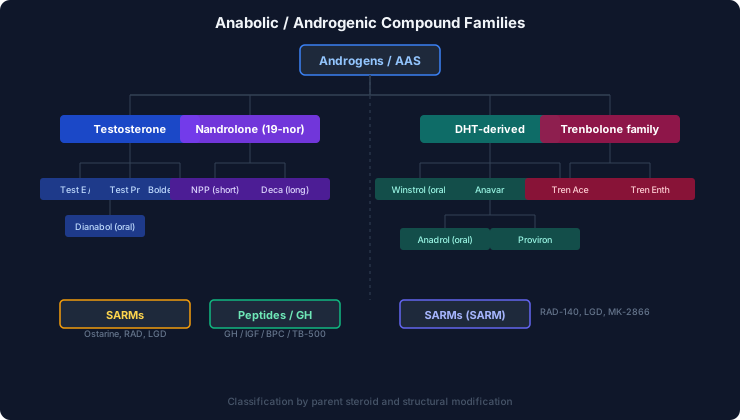
The 19-nor class derives its name from the structural modification defining it: removal of the carbon-19 methyl group from the testosterone backbone. This single modification fundamentally changes the compound’s interaction with several enzymatic pathways and receptor systems.
Nandrolone is the canonical 19-nor compound and the most clinically studied outside of Testosterone itself. The removal of the C19 methyl group makes Nandrolone a poor substrate for the 5AR enzyme. Where Testosterone is converted by 5AR to DHT, a far more potent androgen, particularly in androgen-sensitive tissues like the scalp, skin, and prostate, Nandrolone is converted to dihydronandrolone, which is actually less androgenic than Nandrolone itself. This enzymatic pathway inversion is why Nandrolone is often described as relatively scalp- and prostate-friendly for its potency level, and why finasteride (a 5AR inhibitor) actually worsens some nandrolone-related androgenic sides rather than improving them, inhibiting 5AR blocks conversion to the less-androgenic metabolite, leaving more parent nandrolone in circulation.
Nandrolone also undergoes aromatization, but at a substantially lower rate than Testosterone, approximately 20% of the rate. The estradiol produced from nandrolone aromatization is estradiol itself (not a unique metabolite), which means standard AI management applies if estrogen elevation becomes an issue. However, the progestogenic activity of Nandrolone is the more clinically significant concern: as a 19-nor compound, Nandrolone binds the progesterone receptor with meaningful affinity (approximately 20% of progesterone’s binding affinity by some assays). This matters because progesterone receptor activation synergises with estrogen receptor activation to lower the threshold for gynecomastia. A user on Nandrolone with modest estradiol elevation may develop gyno that would not have appeared at the same estradiol level without the progestogenic activity. Additionally, prolactin elevation, which can occur independently via 19-nor-driven mechanisms, further potentiates this risk. The practical implication: on Nandrolone, manage both estrogen and prolactin, not estrogen alone.
Trenbolone shares the 19-nor backbone but is structurally distinct from nandrolone, carrying a C9 and C11 double bond. Trenbolone does not aromatize at all. It has no estrogen-producing pathway. This is pharmacologically meaningful but not uniformly advantageous: without estradiol production, users on Trenbolone-only protocols often experience joint discomfort, low libido, mood dysregulation, and impaired lipids metabolism, because physiological estrogen performs critical roles in male health including collagen synthesis, neuroprotection, and HDL maintenance. Trenbolone’s progestogenic activity is substantially higher than Nandrolone’s, it binds the progesterone receptor with roughly equal or greater affinity than progesterone itself by some measures. Its binding affinity at the AR is approximately three to five times that of Testosterone, and it does not undergo 5AR conversion to a less potent metabolite. It is also a potent glucocorticoid receptor partial agonist, which contributes to its documented effects on mood, sleep, and anxiety, a mechanism that operates entirely outside the AR pathway.
Trestolone (MENT) is another 19-nor compound deserving mention. Like Trenbolone, it does not undergo 5AR reduction but, unlike Trenbolone, it does aromatize, producing estradiol. Its binding affinity at the AR is reported at approximately ten times that of Testosterone, making it the most potent androgen in widespread experimental use. Its progestogenic activity is also high.
The DHT-Derived Family: Masteron, Anavar, Winstrol, and the Dihydro Compounds
The DHT-derived family begins with DHT itself, the 5-alpha-reduced metabolite of Testosterone produced primarily in androgen-sensitive peripheral tissues. DHT cannot aromatize to estrogen, because the C4-5 double bond reduction that defines 5-alpha reduction also eliminates the substrate recognition site required for aromatase activity. This property is preserved in all DHT derivatives, making the entire class non-aromatizing by definition.
Masteron (drostanolone) is a DHT derivative with a 2-alpha methyl modification that prevents its inactivation by 3-hydroxysteroid dehydrogenase in muscle tissue, the enzyme that converts DHT back to an inactive androstanediol. This significantly extends Masteron’s active life in muscle and explains why it is more anabolically effective than DHT despite similar receptor binding. Masteron is often described as anti-estrogenic, but that reputation is better understood as no aromatization, less water, lower SHBG, and a harder androgenic look rather than reliable aromatase inhibition. It should not be used as a replacement for a real AI when estradiol is genuinely high. Masteron is particularly valued in contest preparation because it contributes to hardness and density without adding estradiol.
Anavar (oxandrolone) occupies a unique position in the DHT family. Its 2-oxa substitution (oxygen replacing carbon at position 2) and its C-17 alpha-alkylation make it orally bioavailable and significantly resistant to hepatic metabolism, which is why its half-life is approximately 9–10 hours despite being a 17-aa oral compound. Anavar’s most clinically notable property is its ability to markedly suppress SHBG at doses as low as 20–40 mg/day, which substantially raises free testosterone (and free fractions of other co-administered androgens) without introducing new androgenic load. It has essentially no progestogenic activity, does not aromatize, and produces the lowest reported hepatotoxic profile among all oral 17-aa steroids, though hepatic impact exists and warrants monitoring.
Winstrol (stanozolol) is structurally unusual, it contains a pyrazole ring attached at positions 3 and 2 of the DHT backbone, making it a heterocyclic steroid rather than a purely carbocyclic one. Winstrol aggressively suppresses SHBG, reliably raising free fractions of all co-administered hormones. This interaction is dose-dependent and occurs at doses as low as 10–20 mg/day. Winstrol notably does not aromatize and produces a dry, vascular appearance, but at the cost of significant joint discomfort in many users (due to its combined SHBG suppression and lack of estrogenic joint lubrication) and meaningful HDL depression even at low doses.
Progestogenic Activity: The Clinical Reality
Progesterone receptor (PR) activation by 19-nor compounds is frequently discussed but often poorly understood. The clinical relevance derives from the PR’s interaction with breast tissue: progesterone receptor expression in breast tissue is upregulated by estrogen, and PR activation in combination with estrogen receptor activation has a synergistic effect on ductal and lobular proliferation. In males, this means that the threshold estradiol level required to initiate or worsen gynecomastia is substantially lower in the presence of progesterone receptor activation than it would be with estrogen acting alone.
This has a specific practical implication: a user running Nandrolone or Trenbolone alongside even a modest testosterone base may develop gyno at an estradiol level that would otherwise be tolerable. Managing only estrogen in this context is insufficient. The correct management framework combines estrogen management (with an AI if necessary) with prolactin management (with Cabergoline if prolactin is elevated) and careful baseline estrogen control to prevent synergistic receptor activation. The notion that Cabergoline alone treats 19-nor-induced gyno is incorrect, cabergoline addresses elevated prolactin, not direct PR activation, and the two mechanisms are independent.
Oral vs. Injectable: First-Pass Metabolism and Hepatotoxicity
The pharmacokinetic distinction between oral and injectable compounds is fundamental. Oral compounds must survive gastrointestinal absorption and transit through the hepatic portal circulation, the “first pass”, before reaching systemic circulation. Most steroids are extensively metabolised during first pass, leaving little active compound in systemic blood. 17-alpha alkylation (17-aa) addresses this by introducing a methyl or ethyl group at the C17 position, blocking the enzymatic attack that would otherwise degrade the steroid during first pass. This structural modification is what makes Dianabol, Anadrol, Anavar, Winstrol, Turinabol, Superdrol, and Halotestin orally bioavailable.
The price of 17-aa is hepatotoxic potential. By forcing the liver to repeatedly process a compound it cannot efficiently metabolise on first pass, 17-aa steroids create a hepatic enzyme load that elevates ALT and AST in a dose- and duration-dependent manner. The severity varies significantly across compounds: Anavar is among the mildest; Superdrol and Halotestin are among the most severe. Duration of use is often more important than dose, a 6-week oral cycle at moderate dose is considerably less hepatotoxic than the same dose run for 12 weeks. Concurrent alcohol use dramatically potentiates hepatic stress and should be treated as contraindicated during any oral compound cycle. TUDCA (tauroursodeoxycholic acid) is the best-evidenced hepatoprotectant for this application, with clinical data showing mitigation of bile acid-induced hepatocyte apoptosis.
Injectable compounds administered intramuscular or subcutaneous bypass first-pass metabolism entirely, entering systemic circulation via the lymphatic system before reaching the liver. Hepatic passage still occurs as part of normal circulation, but the liver processes the compound in concentrations far lower than the bolus it would receive during first pass. Injectables therefore produce minimal hepatic enzyme elevation under normal use.
The Wet vs. Dry Spectrum: Estrogen, Progesterone, and Water
The colloquial “wet” vs. “dry” classification maps directly onto a compound’s hormonal conversion profile. Wet compounds are those that aromatize substantially, producing estradiol, and/or activate the progesterone receptor, leading to water and sodium retention, softer appearance at similar body fat percentages, and more pronounced gyno risk. Dry compounds either do not aromatize (or do so at very low rates) and have no progesterone receptor activity, producing harder, drier appearance and lower gyno risk.
The wettest compounds are those with high aromatization rates: Testosterone (high), Dianabol (high, it aromatizes to methylestradiol, which is more potent than estradiol and not suppressed by all AIs equally), Equipoise (low-moderate; its metabolite estrone is less potent), and Anadrol (complex, not classically aromatizing but associated with significant estrogenic activity via a poorly-understood independent mechanism, possibly direct estrogen receptor agonism). The driest compounds include Trenbolone (zero aromatization, no relevant estrogen activity), Masteron, Winstrol, Anavar, Primo, and Halotestin. Nandrolone sits in an intermediate position, low aromatization rate but progestogenic activity creates a pseudo-wet environment at the breast tissue level when estrogen is not tightly controlled.
Understanding where each compound falls on this spectrum allows you to predict how a stack will behave hormonally, design AI strategies that are appropriate rather than reflexive, and anticipate what the physique effect will be at a given body fat percentage, all of which require compound-family logic rather than compound-by-compound memorization.
Selected references for major clinical, mechanistic, or protocol claims. Community-practice points may not be cited individually.