Advanced Health Management and Longevity
Organ protection, cardiovascular risk, kidney and liver monitoring, and the long-term tradeoffs that matter once PED use moves beyond a single cycle.
On this page
Beyond Managing Symptoms
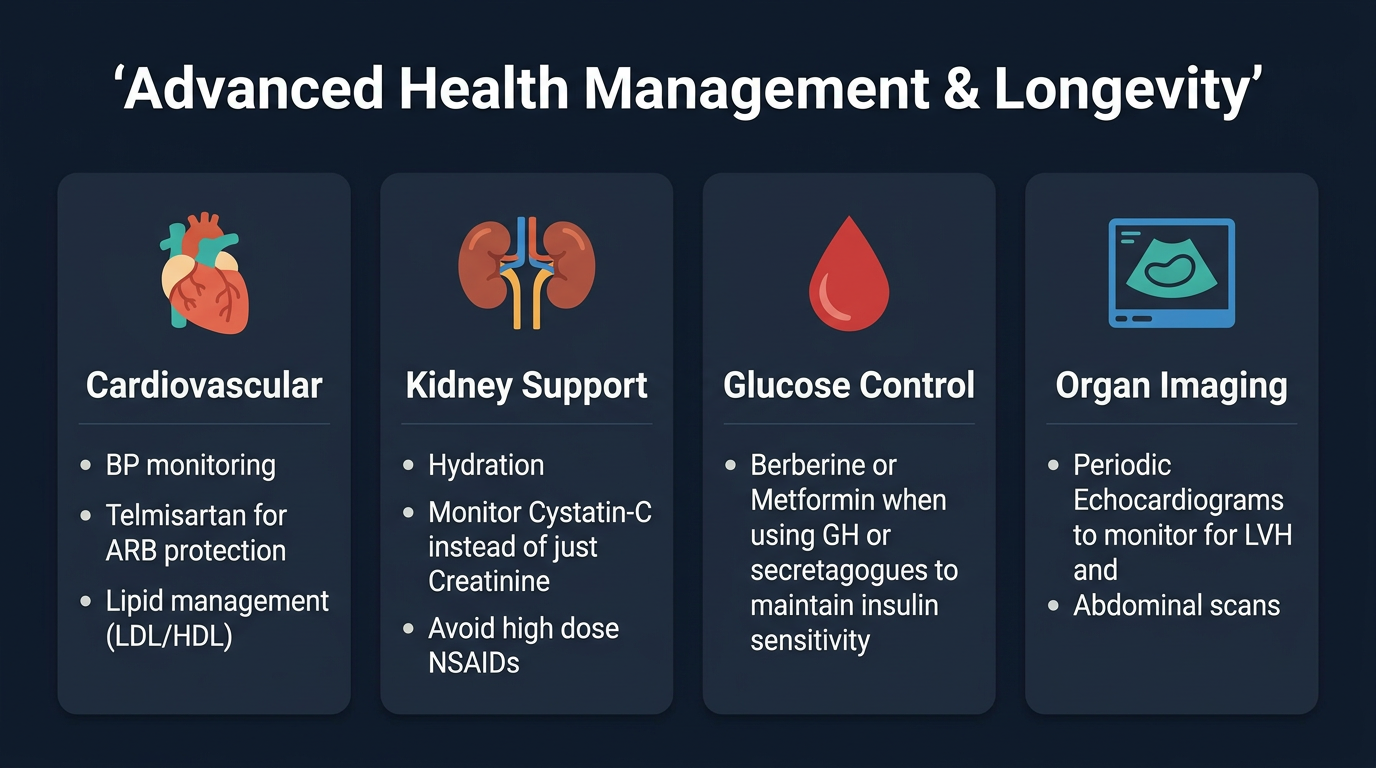
Early on, health management means side-effect control: acne, nipple sensitivity, sleep disruption, rising hematocrit. That frame is too shallow once you have years of use behind you. The real question becomes: what cumulative damage pathways are being pushed, how do they interact, and which of them is most likely to set the ceiling on how long you can keep using before the costs mount up?
A lot of experienced users fool themselves here. They assume they are “healthy” because they are lean, strong, have visible abs, and can still train hard. None of those things rule out left-ventricular remodeling, atherogenic lipid drift, renal hyperfiltration, endothelial dysfunction, or worsening glucose control. Performance and subclinical damage coexist all the time.
The advanced user therefore needs a different mental model. Stop thinking organ by organ in isolation. Think in interacting stress systems: blood pressure increases cardiac afterload and accelerates renal damage; rising hematocrit worsens viscosity and compounds blood-pressure burden; poor lipid profile worsens long-term vascular risk; GH-family compounds worsen insulin sensitivity, which feeds back into vascular and renal risk. The body does not care which drug caused which part of the problem. It only experiences the total load.
The Primary Longevity Threat Is Cardiovascular, Not Cosmetic
The long-term ceiling on PED use is usually set by the cardiovascular system. That is true even in users who are more worried about liver values, acne, or fertility. The heart and vasculature absorb the combined effect of blood pressure, lipid injury, blood viscosity, endothelial stress, sleep apnea, insulin resistance, and chronic sympathetic overactivation. These do not need to produce obvious symptoms early in order to matter.
If you are serious about longevity, blood pressure is not just another line item on the checklist. It is the pressure load the left ventricle sees every day, every hour, every beat. Chronic elevation means the heart has to contract against higher afterload. Over time, the ventricle adapts by thickening. That adaptation can look functional at first. Eventually it becomes remodeling, then stiffness, then impaired filling, arrhythmia risk, and a heart that is less tolerant of further abuse.
Users who ignore blood pressure because they still “feel fine” are making one of the most expensive mistakes in the entire PED space. High blood pressure usually feels like nothing until it has been there long enough to matter.
Blood Pressure: The Highest-Value Marker You Can Control
Left Ventricular Hypertrophy ([LVH]) is often discussed in PED circles as if it were mainly a consequence of being big, training hard, or using growth-promoting compounds. Those things matter, but chronic hypertension is the more dangerous driver because it creates constant mechanical stress on the ventricle. A large heart in a trained athlete is not automatically a diseased heart. A ventricle that is thickening because it has been pumping against elevated pressure for years is a different story.
The advanced interpretation question is not just “is BP high?” It is “what is pushing it high?” Common contributors include androgen-driven fluid retention, elevated hematocrit, sleep apnea, stimulants, excess body mass, GH-related water retention, kidney stress, and simply running too much total drug for too long. If you do not identify the main drivers, you end up treating a number without reducing the system stress that created it.
ARBs such as Telmisartan are popular in advanced circles for a reason. They lower blood pressure, reduce RAAS-mediated vascular stress, and are often better tolerated than older blood-pressure drugs in athletic populations. Telmisartan also gets discussed for its mild PPAR-gamma activity, but that feature is often over-romanticized. The main reason to care about it is still blood-pressure control. If you are using an ARB as a permission slip to keep running a stack that is obviously too aggressive, you are using the tool wrong.
Lipids: Stop Obsessing Over HDL Alone
PED users have a bad habit of using HDL as the whole story. HDL matters, but if you want an advanced longevity framework, ApoB is the cleaner signal. ApoB reflects the number of atherogenic particles in circulation, not just the amount of cholesterol they are carrying. That makes it a better marker of how much traffic is hitting the arterial wall.
Many PED compounds shift the lipid environment in an atherogenic direction even when the standard panel does not fully capture the damage. Oral 17-aa compounds are especially bad here. They often crater HDL dramatically, but the bigger issue is broader than “HDL is low.” The particle environment becomes more hostile, endothelial injury becomes easier, and plaque biology gets a better substrate to work with.
For the advanced user, the practical hierarchy is:
- blood pressure first, because it is such a high-force chronic stressor
- ApoB next, because it speaks directly to atherogenic particle burden
- HDL as supporting context, not the whole cardiovascular story
If ApoB is climbing and blood pressure is mediocre, you are not in a longevity-friendly place no matter how good your pumps are.
Viscosity, Hematocrit, and Why “Just Donate Blood” Is Not a Strategy
Rising hematocrit is often treated casually in enhanced populations because the fix feels straightforward: donate blood, watch the number drop, carry on. That mindset misses the point. The number is not the disease, it is the signal that your current protocol is driving red-cell mass faster than your system can tolerate comfortably.
Higher hematocrit increases viscosity. Higher viscosity increases vascular resistance and makes blood-pressure control harder. It also changes how easily blood moves through smaller vessels and compounds the stress placed on the heart. If hematocrit, blood pressure, and sleep apnea are all drifting in the wrong direction at once, the user is not dealing with three separate issues. He is dealing with one integrated cardiovascular problem.
Therapeutic phlebotomy or standard blood donation can be useful acute tools, but they are not a complete strategy. If a user needs to keep donating to stay inside safe numbers while changing nothing else, the protocol is telling on itself. Dose, compound selection, hydration status, cardio base, sleep quality, and apnea risk all need to be examined, not just the hematocrit result.
Echocardiography: Trajectory Matters More Than Single Snapshots
Advanced health management should include structural cardiac thinking, not just blood tests. Echocardiography is the best practical window into whether the heart is adapting in a benign way, a concerning way, or a mixed way. Wall thickness, chamber size, diastolic function, and overall trajectory matter more than a single number taken out of context.
The key word is trajectory. A mildly abnormal echo once is less useful than serial comparison over time. If wall thickness is creeping upward, if filling dynamics are worsening, or if the heart is becoming less compliant while blood pressure has been running high for years, that should change behavior. This is one reason advanced users need to stop thinking in cycle-length timeframes only. Longevity decisions require multi-year pattern recognition.
Kidney Risk Is Usually Hemodynamic First
The kidneys are often described as “silent victims” of PED use, which is true, but the mechanism gets oversimplified. In most advanced users, kidney stress is not coming from protein intake alone, and it is not best understood as “creatinine looks high because I lift.” The more important renal story is hemodynamic.
Chronic hypertension increases intraglomerular pressure. Increased blood viscosity worsens perfusion characteristics. Repeated dehydration reduces renal reserve. NSAID use impairs prostaglandin-mediated renal blood flow. GH-family compounds can worsen fluid dynamics and glucose handling. Over time, these factors push the kidneys toward damage even when the user still looks outwardly healthy.
Creatinine Is a Blunt Tool in Muscular People
Creatinine-based eGFR is useful, but in very muscular users it is easy to overread a mildly abnormal number. High muscle mass and creatine use both push creatinine upward. That does not mean kidney function is automatically fine. It means the interpretation needs more resolution.
Cystatin-C becomes more valuable here. It is less distorted by muscle mass and gives a cleaner sense of filtration status in heavily trained populations. Even then, a single kidney marker is not enough. The advanced lens is pattern-based:
- creatinine/eGFR trend
- Cystatin-C trend
- blood pressure trend
- hydration status
- urinary protein or albumin signal if available
If multiple parts of that picture are drifting in the wrong direction, the right response is not to argue with the lab. It is to reduce renal stress.
NSAIDs, Dehydration, and Cutting-Phase Kidney Damage
Some of the most avoidable kidney stress in advanced users comes from behavior that is so normal in bodybuilding that people stop seeing it: frequent NSAID use, aggressive cutting dehydration, stimulant-heavy appetite suppression, and pushing training volume while under-recovered.
A lean, dry look is not protective. In many cases it is exactly the state where kidney perfusion is most fragile. Add NSAIDs on top of that and you create a very predictable setup for renal strain. Advanced health management therefore cannot be separated from phase context. The same stack can be tolerated differently in a well-fed, hydrated gaining phase than in a dehydrated, stimulant-heavy cutting phase.
GH, MK-677, and the Glucose Side of Longevity
Advanced stacks often bring the GH-IGF-1 axis into play, either directly with hGH or indirectly through secretagogues like MK-677. Many users then start thinking in terms of “recovery” and “fullness” while ignoring the metabolic bill that arrives later.
Growth hormone has a split physiology. It supports growth signaling and raises IGF-1, but it also antagonizes insulin action. At the tissue level, GH tends to reduce insulin sensitivity and increase hepatic glucose output. That means the user can look fuller, recover well, and still be drifting toward worse fasting glucose, higher insulin, and a more diabetic metabolic environment if exposure is high enough or long enough.
Advanced users need to stop treating fasting glucose as a checkbox and start treating glucose control as part of cardiovascular risk. Poor glucose control damages vasculature, worsens renal stress, and compounds the same long-term outcome profile that bad blood pressure and bad lipids are already pushing.
The IGF-1 Signal Is Not the Same as Metabolic Safety
A rising IGF-1 level tells you the axis is being engaged. It does not tell you the protocol is safe. A common mistake in the GH world is seeing the biomarker rise and assuming the rest of the metabolic system must also be favorable. It often is not.
The more useful advanced question is: what is happening to IGF-1, fasting glucose, fasting insulin, HbA1c, bodyweight, and edema at the same time? That combined picture tells you whether the protocol is staying inside a tolerable metabolic lane or whether it is buying a cosmetic/performance benefit by quietly degrading insulin sensitivity.
Adjuncts Only Matter If the Base Is Sensible
Advanced users often employ tools like Berberine, Metformin, Omega-3s, Citrus Bergamot, ARBs, TUDCA, or blood donation. Some of these are reasonable. The problem is not that people use support strategies. The problem is that support strategies become camouflage for a stack that is already too harsh.
Honesty matters most here. If the adjunct list keeps getting longer, the stack is usually not being managed brilliantly. It is being rescued repeatedly. There is a difference between thoughtful support and pharmacological debt service.
Metformin, for example, can make sense in some GH-heavy or insulin-resistant contexts. But it is not a license to ignore body-fat level, food quality, cardio, sleep, or dose escalation. Telmisartan can help blood pressure and renal protection, but it does not erase the cost of chronically high androgen load. TUDCA can help with cholestatic strain during oral use, but it does not make abusive oral use into a good idea.
The Practical Monitoring Hierarchy
If you want a usable advanced longevity framework, monitor in layers.
Layer one: the high-value basics. Blood pressure, CBC/hematocrit, standard lipid panel, liver panel, kidney markers, fasting glucose, and bodyweight trend.
Layer two: the clarifiers. ApoB, Cystatin-C, IGF-1, fasting insulin, HbA1c, and urinary protein/albumin signal where available.
Layer three: structural follow-up. Echocardiography in users with long exposure, persistent hypertension, significant size, sleep-apnea risk, or concerning symptoms/history.
Do not collect every biomarker just because more data feels advanced. Collect the data that changes decisions.
The Longevity Filter for Any Stack
Before evaluating whether a stack is “worth it,” run it through a longevity filter:
- What is it likely to do to blood pressure?
- What is it likely to do to ApoB and HDL?
- What is it likely to do to hematocrit?
- What is it likely to do to glucose control?
- What additional support drugs will it require?
- How easy will it be to detect early damage if things drift?
A stack that gives a big cosmetic payoff but worsens every one of those categories at the same time is not advanced. It is expensive.
A Longevity Mindset
The advanced PED user should be less impressed by intensity and more impressed by sustainability. The impressive thing is not how much pharmacology someone can tolerate for twelve weeks. The impressive thing is how little damage they accumulate across years.
That usually means fewer compounds, longer periods at lower total exposure, tighter blood-pressure control, more respect for glucose drift, less casual oral use, better sleep, better cardio base, and less emotional attachment to staying huge all the time.
Longevity is not a supplement category. It is a decision style. If your health markers keep forcing rescue interventions, if your echo trajectory is worsening, if your blood pressure needs constant cleanup, or if your glucose control is drifting every time GH-family drugs enter the plan, the body is already answering the question for you. The only thing left is whether you are willing to hear it.
Selected references for major clinical, mechanistic, or protocol claims. Community-practice points may not be cited individually.