Monitoring Compliance and Reading Bloodwork
How to use CompoundLab to educate clients about compounds, interpret client-reported bloodwork for concerning trends, and build a practical monitoring framework across a client's cycles.
- Use CompoundLab to structure educational conversations about specific compounds with clients
- Interpret client-reported bloodwork to identify trends that warrant concern or referral
- Track blood pressure, hematocrit, lipids, and liver enzymes across a client's cycles systematically
- Build and apply a client monitoring checklist across the arc of a cycle
- Identify the difference between trends that warrant pausing versus stopping entirely
On this page
Why Monitoring Is a Coaching Responsibility
A coach who accepts a client using or planning to use anabolic compounds without building a monitoring framework into the relationship is not providing harm-reduction-informed coaching, they are providing programming with an attached liability for whatever happens next. Monitoring is not bureaucratic overhead. It is the practical mechanism by which you protect your clients, protect yourself, and fulfil the educational role that distinguishes responsible coaching from simply watching someone lift while they make unsupervised health decisions.
Monitoring in this context has two distinct layers: objective markers (bloodwork, blood pressure, measurable physiological data) and subjective reporting (how the client feels, what symptoms they notice, whether they are actually following the protocols discussed). Both matter, and both require a systematic approach rather than ad hoc check-ins.
Using CompoundLab to Educate Before a Cycle Begins
The most valuable use of CompoundLab in the coaching relationship is pre-cycle education, before the client injects anything, while they still have full flexibility to adjust their approach based on what they learn.
When a client presents a compound they intend to use, say, Testosterone Enanthate as a first cycle, walk through the compound profile together. The profile covers the mechanism of action (endogenous androgen replacement with all the downstream effects of supraphysiological testosterone), the ester and half-life (Enanthate is a 7-day half-life requiring twice-weekly pinning to maintain stable blood levels), the suppression dynamics (LH and FSH will fall to near-zero within 2–4 weeks; the HPTA is fully suppressed during the cycle), and the side effect profile (aromatization to estradiol requiring monitoring, hematocrit elevation from erythropoiesis stimulation, lipid suppression of HDL, SHBG changes affecting free testosterone).
This conversation accomplishes several things simultaneously. It ensures the client has accurate, detailed information rather than forum anecdotes. It identifies gaps in their understanding, a client who did not know that Testosterone significantly suppresses LH and FSH needs to understand the implications for PCT before they start, not halfway through a 20-week cycle. It also establishes a baseline of what you discussed and when, which matters for documentation.
For compounds the client is adding beyond a foundation of Testosterone, perhaps considering Nandrolone Decanoate or Equipoise, the CompoundLab interaction analysis provides a structured way to discuss the combined effects. Nandrolone adds progestogenic activity and deeper HPTA suppression; Equipoise adds appetite stimulation, significant hematocrit elevation risk, and a very long ester (half-life of approximately 14 days with the Undecylenate ester) that complicates PCT timing. These are not things a coach is prescribing, they are things a client needs to understand before making their own decision about whether to proceed.
Building a Monitoring Checklist
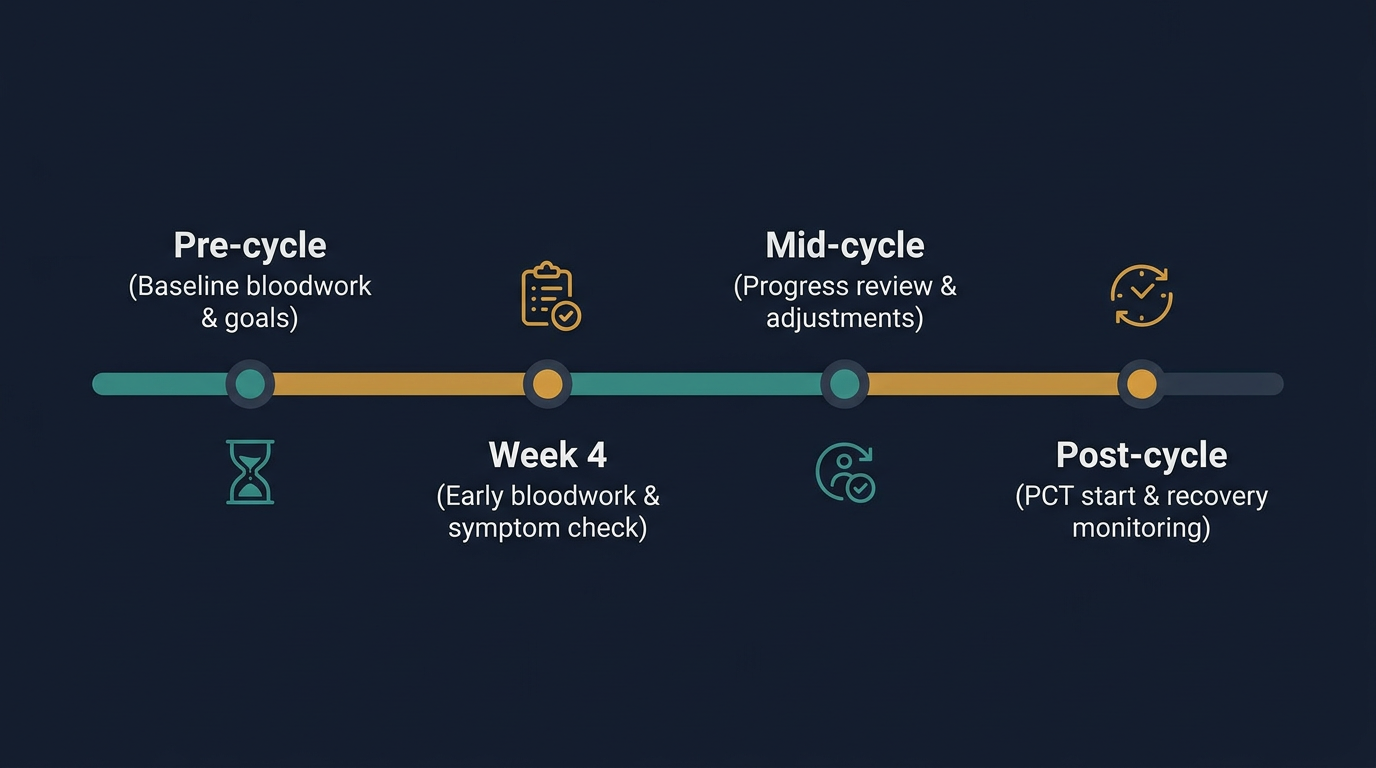
A monitoring checklist formalises what you are tracking and when. It converts “keep an eye on things” into a structured protocol that creates accountability for the client and a record for you. The checklist should be built for the specific compounds the client is using, but the framework below covers the markers that are universally relevant to anabolic compound use.
Blood Pressure. Resting blood pressure should be measured at least weekly during a cycle. A target of below 130/80 is generally considered safe; values consistently above 140/90 warrant dose reduction or cycle pause and physician evaluation. Blood pressure elevation on cycle is often compound-specific: Trenbolone and Anadrol are among the most common causes of significant hypertension. Equipoise, particularly at higher doses, can also elevate blood pressure through hematocrit-driven viscosity increases. Any client who owns a blood pressure cuff should be using it regularly throughout a cycle, it is one of the cheapest and most informative monitoring tools available.
Hematocrit. Hematocrit should be captured at baseline (pre-cycle), at mid-cycle (4–6 weeks in), and post-cycle. The threshold for concern is above 52%, at this level, blood viscosity is meaningfully elevated and thrombotic risk increases. Above 55%, the risk is clinically serious and therapeutic phlebotomy (blood donation or medical blood removal) is the standard intervention. Compounds that stimulate erythropoiesis most aggressively include Testosterone (particularly at higher doses), Equipoise (notable for producing the most significant hematocrit elevation of commonly used compounds), and all forms of Trenbolone. Clients using Equipoise should be aware that hematocrit monitoring is particularly critical.
Lipids. A full lipids panel (total cholesterol, HDL, LDL, triglycerides) should be drawn at baseline and mid-cycle. The primary concern is HDL suppression, HDL below 30 mg/dL is significant cardiovascular risk that accumulates with duration of exposure. Oral hepatotoxic compounds (Dianabol, Anadrol, Winstrol) produce the most dramatic lipid disruption, with HDL reductions of 30–50% from baseline possible. Injectable compounds have more modest effects, but the cumulative impact across a cycle is still meaningful. There is no pharmacological fix for androgen-induced lipid suppression, the interventions are lifestyle-based (cardiovascular exercise, high-dose omega-3 fatty acids, dietary fibre) and the most effective strategy is limiting duration and avoiding hepatotoxic orals.
Liver Enzymes. ALT, AST, and GGT should be drawn at baseline and mid-cycle whenever the client is using any hepatotoxic oral compound. For injectable-only protocols, mid-cycle liver enzyme monitoring is still sensible but the expected effect is smaller. Elevations above 3× the upper limit of normal require immediate cessation of any hepatotoxic compound and medical evaluation. TUDCA (tauroursodeoxycholic acid) has genuine supporting evidence for reducing hepatocellular stress from oral compounds and should be discussed with any client using 17-alpha-alkylated orals.
Hormone Panel. Total testosterone, free testosterone, estradiol, LH, and FSH form the hormone monitoring core. On-cycle estradiol management requires a mid-cycle draw to assess aromatization response, particularly important for clients who are using or considering an AI like Arimidex or Aromasin, as both over-suppression and under-suppression of estradiol carry consequences. Post-cycle, recovery of LH, FSH, and endogenous total testosterone toward baseline is the primary evidence that the HPTA is restarting.
Subjective Weekly Check-In. Beyond objective markers, a weekly structured check-in captures the client’s subjective experience: energy levels, mood stability, sleep quality, libido, joint comfort, and any symptoms they have noticed. This is not a symptom management exercise, you are gathering information that helps you identify when a physician referral is warranted and documenting that you were actively monitoring.
Interpreting Client-Reported Bloodwork: What to Look For
Your role in interpreting bloodwork is pattern recognition at a general level, identifying values or trends that warrant concern and directing the client to appropriate medical guidance. You are not diagnosing or treating; you are screening for signals.
The most important interpretive habit is comparing against the client’s own baseline rather than laboratory reference ranges. Reference ranges describe population distributions; your client’s individual baseline may sit quite differently within that distribution. A total testosterone of 500 ng/dL post-cycle looks normal against the range but may is significant suppression if the client’s pre-cycle baseline was 850 ng/dL. Always bring baseline values into the comparison.
Trend is more informative than any single value. A hematocrit that is 48% at baseline, 51% at mid-cycle, and 53% at the end of cycle is telling a story: it is elevated and rising. A single hematocrit of 51% in isolation is less alarming than that same value in the context of a rising trend. Build a tracking system that plots values over time so you and the client can see direction, not just snapshots.
For estradiol, the practical range for male wellbeing is generally described as 20–40 pg/mL, with some literature supporting up to 50 pg/mL as acceptable on cycle. Values above 60–70 pg/mL begin to produce the clinical picture associated with estradiol excess: water retention, mood instability, gynecomastia progression, and reduced libido. Values below 15 pg/mL, usually from aggressive or unnecessary AI use, produce a different but equally problematic picture: joint pain, low libido, mood depression, impaired strength and nitrogen retention.
For lipids, watch HDL as the primary concern marker. An HDL below 35 mg/dL mid-cycle is concerning; below 25–30 mg/dL is a serious signal. LDL elevation is less immediately dangerous than HDL suppression in the short term but contributes to long-term atherosclerotic risk. Triglycerides above 500 mg/dL carry a risk of pancreatitis.
For liver enzymes, any value above 3× the upper limit of normal should trigger an immediate conversation: stop the hepatotoxic compound, report to a physician, and do not restart without clinical guidance. Values in the 2–3× range are concerning but not immediately alarming; they warrant increased monitoring frequency and discussion about whether the risk-benefit analysis of continuing the oral compound justifies continued use.
Pausing vs. Stopping Entirely
The decision framework for when to pause versus when to stop a cycle entirely is one of the most practically important things you can help a client understand before they begin. Front-loading this conversation, having it explicitly before the needle ever goes in, prevents motivated reasoning under pressure mid-cycle, when a client who is invested in finishing a cycle will rationalise warning signs.
Pause and investigate is the appropriate response when a marker is elevated or trending in the wrong direction but has not yet reached a level that signals immediate harm. Hematocrit above 52% and continuing to rise. Liver enzymes in the 2–3× range. Estradiol above 60 pg/mL despite AI use. Blood pressure consistently above 140/90. HDL below 30 mg/dL. These are all signals to reduce dose, address the specific issue (phlebotomy for hematocrit, AI adjustment for estradiol, stopping the oral for liver enzymes), and recheck before continuing.
Stop entirely is the appropriate response when values reach levels where continued exposure creates serious risk without meaningful mitigation. Hematocrit above 55%. Liver enzymes above 3× normal. Cardiac symptoms, chest pain, dyspnoea, palpitations. Significant uncontrolled hypertension above 160/100. Severe psychological symptoms. In these situations, the conversation with the client is about how to stop safely and what comes next.
For stopping a long-ester cycle safely: injectable compounds cannot be switched off; they must clear. The client needs to understand that suppression continues for weeks after the last injection of a long-ester compound like Testosterone Enanthate or Nandrolone Decanoate. The monitoring requirement does extend through clearance, PCT if applicable, and post-cycle recovery.
Selected references for major clinical, mechanistic, or protocol claims. Community-practice points may not be cited individually.