Advanced Client Scenarios and Escalation Frameworks
How to handle clients who want to add compounds prematurely, clients with poor bloodwork who want to continue, blast-and-cruise long-term management, supporting a client through PCT, and when to end the coaching relationship.
- Apply a structured response framework when a client wants to add compounds before they are ready
- Determine an appropriate response when a client presents poor bloodwork and wants to continue
- Understand the specific long-term monitoring obligations when coaching a blast-and-cruise client
- Describe the coach's role in supporting a client through PCT and post-cycle recovery
- Identify the conditions that ethically require ending a coaching relationship
On this page
Scenarios That Test Professional Standards
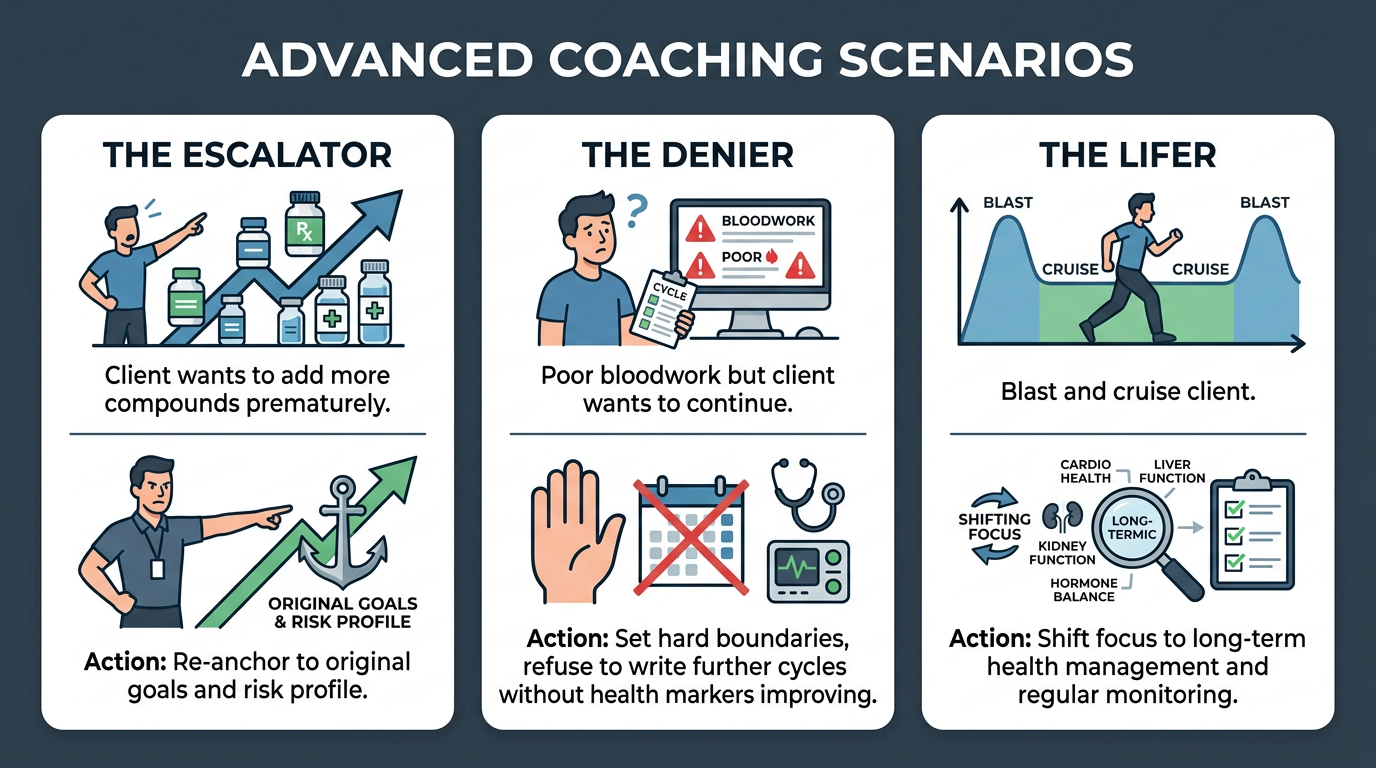
The early part of a coaching relationship is often straightforward: the client is new, motivated, and receptive to guidance. The tests come later, when plateaus hit, when ambition outpaces readiness, when bloodwork comes back problematic and the client wants to rationalise continuing anyway, when the long-term trajectory of sustained compound use creates compounding health complexity.
Advanced scenarios are where professional standards either hold or don’t. The frameworks in earlier lessons, screening, boundaries, monitoring, side effect communication, converge here in specific situations that require judgment, direct communication, and sometimes difficult decisions. This lesson works through those scenarios systematically.
Scenario One: Adding Compounds Before the Client Is Ready
The most common advanced scenario is the client who, after some months on a Testosterone-based protocol that is working well, decides they want to add something. It might be Trenbolone, Nandrolone, Equipoise, or an oral compound like Dianabol. The timing is typically premature, they have not yet run a full cycle to completion, their bloodwork monitoring is incomplete, they have not established how their body responds to what they are already on, and their training and diet have not yet been brought to the level that would maximise the return from adding additional compounds.
The request is almost always framed as research-based: the client has read about the compound, has a rationale, and presents it confidently. The confidence is often a signal in itself. The clients who are most ready to add compounds are typically the ones who ask the most cautious questions about it; the clients who are least ready are often the ones who come in having already decided and seeking validation.
Your response in this scenario should be structured around three points. First, acknowledge that compound escalation is a legitimate progression for someone who meets the criteria, you are not dismissing the idea, you are applying a framework for when it is appropriate. Second, be specific about what criteria are not yet met: has the client completed a full cycle from start to PCT with comprehensive mid-cycle bloodwork? Do you have stable baseline markers? Has the response to current compounds been thoroughly characterised? Have training and nutrition reached a level that justifies additional hormonal support? Third, be direct about what adding a compound with a significantly different risk profile, particularly Trenbolone, with its cardiovascular and neurological risk profile, requires monitoring infrastructure that may not yet be in place.
For Trenbolone specifically, a responsible framing is this: Trenbolone has no approved human medical use, the highest androgenic potency of any compound in common recreational use, a documented cardiovascular risk profile, significant neurological and psychiatric side effects in a meaningful proportion of users, deep HPTA suppression that is typically slower to recover than Testosterone-only suppression, and essentially no safety margin for users who are not comprehensively monitoring cardiovascular markers. A client who has done one Testosterone cycle with incomplete bloodwork and is now interested in Trenbolone has not built the foundation from which that compound can be used responsibly. That is an honest risk assessment grounded in the compound’s profile.
For compounds with a more modest incremental risk, Nandrolone Phenylpropionate added to an established Testosterone protocol in a thoroughly monitored client, for example, the framework applies but the urgency of the “not yet” conversation is lower. Focus on what specific things need to be in place: prolactin baseline, estradiol stability, hematocrit within safe range, understanding of the extended suppression implications for PCT timing with 19-nor compounds.
Scenario Two: Poor Bloodwork, Client Wants to Continue
A client presents mid-cycle bloodwork. HDL is at 26 mg/dL (from a baseline of 52 mg/dL). Hematocrit is 54%. Liver enzymes are elevated at 2.5× normal, likely because the client added an oral compound without telling you. They want to continue the cycle because they are “feeling great” and have a competition in six weeks.
This is the scenario that most concretely tests your professional standards. The client feels good, anabolic compounds often produce subjective wellbeing that is disconnected from objective markers, which is precisely what makes them seductive and what makes objective monitoring so critical. Feeling great is not a safety measure. An HDL of 26 mg/dL while the liver is under stress and hematocrit is approaching the 55% danger threshold is not a situation where the cycle should continue as planned.
Your role in this conversation is to present the objective data clearly, explain what it means in terms the client understands, and be honest about what the responsible course of action is. You are on the same side as the client, and their long-term health is the shared goal. The honesty cannot be softened to the point of ineffectiveness.
The conversation might look like this: “Let’s go through what your bloodwork is actually telling us. Your HDL has dropped from 52 to 26, that’s a 50% reduction in the cholesterol that protects your arteries, and that level of suppression, sustained over six more weeks, is adding measurable cardiovascular risk. Your hematocrit at 54% means your blood is significantly thicker than it should be, which raises your risk of a clot. And your liver enzymes, I need you to tell me honestly whether you added an oral compound, because that elevation is not consistent with injectables alone. These three markers together are telling a story that the answer to is not continuing on the same path for six more weeks.”
From there, present options: cease the oral compound immediately and retest liver enzymes in two weeks; consider therapeutic phlebotomy for hematocrit (this requires medical guidance, not a coaching decision); and have an honest conversation about whether the competition goal is worth the health cost. The competition is replaceable. The health consequences of a cardiovascular event are not.
Document this conversation in detail. If the client overrides your recommendation and continues against your explicit guidance, document that too. Your professional responsibility is to provide accurate information and honest assessment. The decision, ultimately, is the client’s, and if they make a decision that you cannot support, the relationship needs to be reassessed.
Scenario Three: The Blast-and-Cruise Client Long-Term
Blast and cruise, the practice of maintaining continuous exogenous androgen use year-round, alternating between higher “blast” doses and lower “cruise” doses rather than cycling off and recovering, represents a distinct long-term coaching scenario with its own specific obligations.
A client on a long-term blast and cruise protocol has, by definition, made the decision to permanently suppress their endogenous HPTA. Their LH and FSH will remain near zero indefinitely. Their total testosterone is entirely exogenous. This is a fundamentally different health context from cycling with intervening recovery periods, and it requires a different monitoring framework.
The core monitoring obligations for a long-term blast and cruise client are more intensive than for cycling clients, not less. Hematocrit should be checked quarterly at minimum, the cumulative erythropoietic stimulation of continuous androgen exposure creates ongoing hematocrit elevation risk that does not plateau and reset with off-cycle recovery. Therapeutic phlebotomy may become a routine part of management, which requires ongoing coordination with a physician. Lipids should be checked quarterly. Liver enzymes should be monitored whenever oral compounds are included in blast phases. Cardiac monitoring, echocardiography to assess left ventricular structure and function, is appropriate annually for any long-term blast and cruise client, given the evidence for androgen-induced cardiac remodelling with sustained supraphysiological exposure.
Estradiol management on a blast and cruise protocol requires particular care. Cruise doses are typically closer to TRT-range doses of Testosterone, and at TRT levels, aromatization to estradiol needs to be sufficient (not suppressed) for bone, cardiovascular, and cognitive health. An AI that was appropriate during a high-dose blast phase should typically not be continued at the same dose during a cruise, this is a frequent error that produces low-estradiol symptoms during what should be a recovery-oriented interlude.
The long-term health conversation with a blast and cruise client should also address fertility. Indefinite HPTA suppression means indefinite infertility unless hCG or other interventions are used to maintain intratesticular testosterone and FSH-driven spermatogenesis. For clients in the family planning years, this requires a deliberate, proactive decision rather than a passive default.
Finally, the blast and cruise client is effectively committed to exogenous hormone management for the foreseeable future. The coaching relationship should explicitly acknowledge this and ensure the client has a physician who is aware of their protocol and providing appropriate medical oversight. This is not something that can be adequately managed without medical involvement, the complexity of long-term total testosterone management, estradiol balance, hematocrit and cardiovascular monitoring, and the absence of natural endocrine recovery requires clinical infrastructure that coaching cannot replace.
Scenario Four: Supporting a Client Through PCT and Post-Cycle Recovery
PCT, post-cycle therapy, is the structured pharmacological approach to restarting the HPTA after a cycle of suppression. The most common PCT protocols use SERMs, Tamoxifen (Nolvadex) or Clomiphene (Clomid), or both, to competitively block oestrogen receptors in the hypothalamus and pituitary, removing the negative feedback brake and allowing LH and FSH to begin rising again.
As a coach, your role in PCT support is educational and monitoring-focused, not prescriptive. The specific SERM, dose, and duration of PCT is a decision made by the client, ideally with physician input, not a coaching recommendation. What you can and should do is ensure the client understands the timing requirements (start PCT only after long-ester compounds have substantially cleared, for Testosterone Enanthate, typically 2 weeks after the last injection; for Nandrolone Decanoate, 4–6 weeks or longer), the physiological process underway, and the monitoring markers that tell you whether PCT is working.
Post-cycle recovery is a psychologically challenging period for many clients. As total testosterone drops to its nadir, which can be significantly lower than the pre-cycle baseline before the HPTA restarts, symptoms of low testosterone are common and can be significant. Fatigue, low motivation, mood depression, libido loss, and a subjective sense of “crash” are all documented. Some clients experience this as profoundly uncomfortable, particularly after cycles that involved high doses or long durations.
Preparing a client for what this period feels like is one of the most practically valuable things you can do before a cycle ends. The normalisation conversation, “this is temporary, it is a physiological process, the symptoms will resolve as your LH and FSH recover and endogenous total testosterone climbs back toward your baseline”, does not eliminate the discomfort, but it frames it as expected rather than alarming. A client who understands what post-cycle recovery is supposed to feel like is far less likely to make impulsive decisions (jumping back on compounds to escape the crash, or self-administering interventions based on incomplete information) than one who is surprised by the experience.
Monitor LH, FSH, and total testosterone post-cycle at 4 weeks and 8–12 weeks post-PCT completion. Recovery of LH and FSH above 2–3 IU/L and total testosterone returning toward (within 20–30% of) the pre-cycle baseline is the evidence that the HPTA has restarted. If total testosterone remains significantly suppressed at 12 weeks post-cycle with low LH and FSH, the client needs physician evaluation for whether additional intervention, extended PCT, hCG, or specialist assessment, is warranted. Coaching tools are not the right instrument here.
Scenario Five: Ending the Coaching Relationship
Not every coaching relationship should continue indefinitely, and in the context of PED-assisted coaching specifically, there are conditions that ethically require ending the relationship.
The clearest case is persistent non-compliance that creates genuine risk. A client who continues to ignore explicit guidance, who runs hepatotoxic orals on top of bloodwork that already shows elevated liver enzymes, who dismisses hematocrit values above 54% as “not a problem,” who runs compounds you have explicitly said you cannot support, has made it impossible for you to fulfil your role as a harm-reduction-informed coach. If your professional function is to support responsible use and reduce harm, and the client is systematically ignoring the information and recommendations that define responsible use, you are no longer providing meaningful harm reduction. You are providing social legitimacy for reckless decisions, which is a different and significantly less defensible role.
A second case is any situation where continuing the relationship requires you to take on obligations you cannot ethically or legally fulfil. If a client is asking for things you cannot responsibly provide, specific dosing recommendations, medical interpretation of bloodwork, cycle designs that exceed your role, and the expectation is becoming structural to the relationship, the appropriate response is to redefine the relationship or end it.
A third case is any situation where the client’s welfare is at genuine risk and they are refusing to take action. A client with cardiovascular symptoms who refuses to see a physician. A client experiencing severe psychiatric deterioration who dismisses it. A client who has presented bloodwork that warrants immediate medical evaluation and is rationalising why they don’t need to act on it. Your professional responsibility in these situations is to be explicit about the risk you are observing and to state clearly that you cannot continue to coach someone who is declining appropriate medical care in the face of significant warning signs.
Ending a coaching relationship in this context should be handled with care and documentation. Be clear about why the relationship is ending, not punitive, but specific: “I can no longer support this coaching relationship because [specific condition]. I strongly encourage you to [recommended action]. I hope you will seek the support you need.” Put it in writing. Document what you observed, what you recommended, and the client’s response. This is protective for you and is also, practically, more likely to reach the client in a way that a verbal conversation may not.
The willingness to end a coaching relationship when necessary is a feature of professional practice. A coach who never declines a client, never pauses a relationship, and never ends one regardless of what is happening has no meaningful standards. The standards only have value when they are applied consistently, including in situations where applying them has a cost.
Selected references for major clinical, mechanistic, or protocol claims. Community-practice points may not be cited individually.