Harm Reduction Quick Reference
A compact, scannable reference for core harm reduction principles, minimum prerequisites, red flag conditions, emergency protocols, and trusted resources.
- Recall the core harm reduction principles in a quick-reference format
- Verify readiness using a minimum prerequisites checklist before any first cycle
- Identify red flag conditions that warrant stopping any compound immediately
- Know the emergency protocol for serious suspected side effects
- Access a curated resource list for further guidance and testing services
On this page
Core Harm Reduction Principles
These principles apply universally, regardless of compound, dose, experience level, or goal. They are the non-negotiable foundation of responsible use.
-
Baseline bloodwork before any first cycle. You cannot monitor change without knowing your starting point. Baseline labs are the single highest-value harm reduction action available. There is no retroactive baseline.
-
Understand every compound before using it. Know its mechanism, its half-life, its aromatization profile, its androgenic risks, its hepatotoxic status, and the ancillary compounds it may require. Ignorance is not a harm reduction strategy.
-
Start with the least complex protocol. Testosterone alone for a first cycle is efficiency. Most available gains come from the simplest protocol. Complexity multiplies interaction surfaces, monitoring demands, and side effect ambiguity.
-
Have ancillaries on hand before you start, not after symptoms appear. An AI obtained three days into a cycle when gynecomastia itching has already started is less effective than an AI obtained two weeks earlier. Pre-source Tamoxifen, an AI (preferably Aromasin or Arimidex), and your PCT compounds before the first injection.
-
Mid-cycle bloodwork is not optional. A week 4–6 blood draw catches problems while there is time to act. Hematocrit creeping to 54%, liver enzymes rising sharply, or estradiol crashing from an overzealous AI are all manageable when caught early and serious when caught late.
-
PCT is not optional for discrete cycles. The HPTA does not restart automatically on a reliable timeline. A structured SERM-based PCT substantially reduces the duration of the post-cycle low-testosterone window and the risk of permanent dysfunction.
-
Time off equals time on, at minimum. For users running discrete cycles: equal time off between cycles gives the cardiovascular system, lipid profile, hematocrit, and HPTA time to recover toward baseline. This is a minimum guideline, not a guarantee of full recovery.
-
Report symptoms honestly to medical professionals. Physicians treating you need accurate information. Concealing compound use from a doctor examining you for chest pain, an arrhythmia, a blood clot, or a psychiatric crisis is dangerous. Healthcare providers are ethically obligated to treat you, your safety is worth more than that conversation.
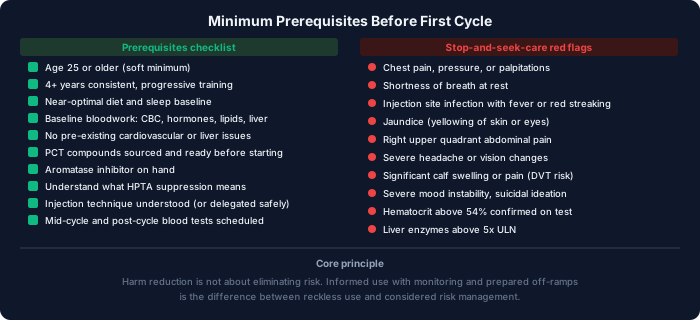
Minimum Prerequisites Checklist: Before First Cycle
Use this checklist as a genuine gate, not a formality. If you cannot check all items, address the gap before proceeding.
Health Prerequisites
- [ ] Age 25 or older (endocrine system fully mature; below this threshold, risk of permanent HPTA dysfunction is substantially higher)
- [ ] Baseline bloodwork completed within the last 6 weeks, off all compounds for 8+ weeks:
- [ ] Total testosterone, free testosterone, SHBG, estradiol (sensitive), LH, FSH, prolactin
- [ ] CBC (including hematocrit and hemoglobin)
- [ ] Full lipids panel (fasted)
- [ ] Liver enzymes: ALT, AST, GGT, bilirubin
- [ ] Comprehensive metabolic panel (kidney function, electrolytes)
- [ ] PSA if age >35
- [ ] All baseline values within acceptable ranges (no pre-existing hematocrit >50%, no significantly elevated liver enzymes, no active cardiovascular condition, no active malignancy)
- [ ] Blood pressure below 130/85 mmHg at rest
- [ ] No active or recent androgen-sensitive malignancy
- [ ] No active hepatic disease
- [ ] No uncontrolled psychiatric condition
Knowledge Prerequisites
- [ ] Can explain how the HPTA works and why suppression occurs
- [ ] Understands the ester being used: its half-life, injection frequency, and time to saturation
- [ ] Understands what aromatization is and how to manage estradiol
- [ ] Has a written PCT plan with start date, compound, and dose schedule
- [ ] Knows what blood values would prompt stopping the cycle
Practical Prerequisites
- [ ] Sterile injection equipment sourced (needles, syringes, alcohol swabs, sharps disposal container)
- [ ] Compound identity verified (ideally via third-party lab testing service or reagent test kit)
- [ ] Ancillaries on hand: AI (Aromasin or Arimidex), PCT compounds (Tamoxifen and/or Clomiphene), TUDCA if using any 17-alpha-alkylated oral
- [ ] Mid-cycle bloodwork scheduled in advance
- [ ] Physician or clinic identified who can provide medical support if needed
Lifestyle Prerequisites
- [ ] Consistent training programme in place (minimum 2 years of serious resistance training)
- [ ] Diet supports the cycle goal
- [ ] Sleep is adequate (7–9 hours)
- [ ] No ongoing alcohol abuse (compounded hepatotoxicity risk; hormonal disruption)
Red Flag Conditions: Stop and Seek Medical Care
The following conditions require stopping the current cycle immediately and seeking medical evaluation. These are not judgment calls to make mid-cycle, they are pre-defined triggers established in advance precisely so that motivated reasoning does not override appropriate action.
Cardiovascular Red Flags
| Symptom | Action |
|---|---|
| Chest pain, pressure, or tightness (especially with exertion) | Emergency room immediately, rule out ACS/MI |
| Shortness of breath with activity that previously did not cause this | Emergency evaluation |
| Palpitations, racing heart, irregular heartbeat persisting >10 minutes | Emergency evaluation or urgent cardiology |
| Severe headache unlike prior headaches (thunderclap onset) | Emergency room, rule out hypertensive emergency, intracranial event |
| Unilateral leg swelling, pain, or warmth | Emergency evaluation, possible DVT |
| Sudden pleuritic chest pain with breathing, blood-tinged cough | Emergency room immediately, possible PE |
| Hematocrit >55% | Stop cycle; therapeutic phlebotomy urgently; medical evaluation |
| Blood pressure >160/100 mmHg on multiple readings | Stop cycle; medical evaluation |
Hepatic Red Flags
| Symptom / Finding | Action |
|---|---|
| Jaundice (yellow skin or whites of eyes) | Stop all compounds; emergency evaluation |
| Right upper quadrant pain | Stop all compounds; urgent medical evaluation |
| Dark brown / cola-coloured urine | Stop all compounds; urgent evaluation |
| ALT/AST >3× upper limit of normal | Stop oral compounds; retest in 2–4 weeks |
| ALT/AST >5× upper limit of normal | Stop all compounds; urgent medical evaluation |
Neurological and Psychiatric Red Flags
| Symptom | Action |
|---|---|
| Visual disturbances on Clomiphene (blurred vision, floaters) | Stop Clomiphene immediately; switch to Tamoxifen only |
| Severe depression with suicidal ideation | Seek psychiatric care; stop cycle; inform treating physician |
| Severe, uncharacteristic aggression or rage | Stop cycle; psychiatric evaluation |
| Signs of stroke: facial drooping, arm weakness, speech difficulty | Emergency room immediately |
Infection Red Flags
| Symptom | Action |
|---|---|
| Fever >38°C (100.4°F) with injection site pain | Medical evaluation, possible abscess or systemic infection |
| Spreading redness (red streaking) from injection site | Urgent medical evaluation, cellulitis |
| Pus, discharge, or fluctuant swelling at injection site | Medical evaluation, likely abscess requiring drainage |
| High fever, rigors, signs of systemic illness | Emergency evaluation, possible bacteraemia / sepsis |
Emergency Protocol: Suspected Serious Side Effects
For symptoms listed above under cardiovascular, neurological, or severe hepatic red flags:
-
Call emergency services (911/999/112) or go to the nearest emergency room immediately. Do not drive yourself if experiencing chest pain, neurological symptoms, or severe shortness of breath.
-
Tell the treating physician what compounds you are using. Withholding that information is not an option. Cardiovascular events, hepatic crises, and infections must be treated based on accurate history. Your safety outweighs any concern about disclosure. Emergency physicians treat substance-related events regularly and without judgment.
-
Bring compound names if possible. Active pharmaceutical ingredient names, “Testosterone Enanthate 250 mg/week, Nandrolone Decanoate 300 mg/week”, are far more useful to a treating physician than the word “steroids.”
-
For injection-site infections: Do not apply heat and wait for an abscess to resolve. Do not attempt self-drainage. Abscesses require medical drainage and antibiotics; untreated, they can progress to necrotising fasciitis or systemic sepsis within hours.
-
Post-emergency: Once stabilised, stop the cycle and allow full recovery. Obtain relevant specialist follow-up (cardiology, hepatology) as directed before considering any future use.
Resource List
Bloodwork and Lab Testing
| Service | Region | Notes |
|---|---|---|
| Ulta Lab Tests | US | Direct-to-consumer; comprehensive panels; no physician required |
| Walk-In Lab | US | Similar to Ulta; good panel selection |
| Request A Test | US | Broader geographic coverage |
| PrivateBloodTests.co.uk | UK | Comprehensive panels; no GP referral needed |
| Medichecks | UK/EU | Strong hormone-specific panels |
| Marek Health | US (telemedicine) | Harm-reduction-informed physician oversight |
| Defy Medical | US (telemedicine) | Works with hormone optimisation context |
Compound Verification
| Service | Purpose |
|---|---|
| Janoshik Analytical | Third-party quantitative assay, compound identity and concentration |
| Reagent test kits (Roidtest, Simon’s) | Colour-change spot tests for basic identity verification; inexpensive; limited but better than no testing |
Strongly recommended: Any compound from an unknown or unverified source should be third-party tested before use. Mislabelled, underdosed, or contaminated compounds are documented and common in the unregulated market. Testing costs $30–80 and provides real chemical identification.
Educational and Medical Resources
| Resource | Notes |
|---|---|
| r/steroids wiki | Community-compiled harm reduction information; frequently updated |
| More Plates More Dates | Evidence-informed compound analysis and bloodwork content |
| PubMed | Primary literature; search any compound name for clinical pharmacology, case reports, and trial data |
| Anabolics, William Llewellyn | Reference text; comprehensive compound profiles |
Recommended Panels Summary
Baseline: Total testosterone + free testosterone (LC-MS/MS), SHBG, estradiol sensitive (LC-MS/MS), LH, FSH, prolactin, CBC with differential, comprehensive metabolic panel, lipids (fasted), ALT/AST/GGT/bilirubin/ALP, TSH/free T3/free T4, PSA if >35.
Mid-cycle: Total testosterone, estradiol sensitive, prolactin (if on 19-nors), CBC (hematocrit/hemoglobin), ALT/AST (if on orals), lipids (fasted).
Post-PCT recovery: Full hormone panel (total testosterone, free testosterone, SHBG, estradiol, LH, FSH, prolactin), CBC, lipids, liver enzymes if orals were used.
Selected references for major clinical, mechanistic, or protocol claims. Community-practice points may not be cited individually.