Ester Reference: Half-Lives, Dosing Frequency, and Compound Pairings
A complete pharmacokinetic reference for all common anabolic esters, half-lives, injection schedules, active fractions, clearance times, and practical guidance on ester selection.
- Identify every major anabolic ester and its associated half-life and dosing frequency
- Calculate active compound dose and clearance time from any esterified preparation
- Understand the pharmacokinetic implications of mixing esters in a single compound
- Select appropriate esters for different experience levels and goals
On this page
What Esters Are and Why They Matter
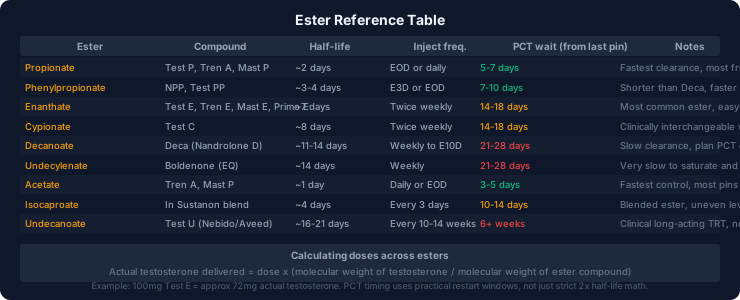
An ester is a chemical modification applied to an anabolic compound by attaching a fatty acid chain to its hydroxyl group. This transforms a fast-clearing free-base hormone into a depot formulation with controlled, predictable release kinetics. Without esterification, injectable Testosterone would require multiple daily injections to maintain stable blood levels, its free-base half-life is only a few hours. With an ester, a single weekly or biweekly injection suffices.
The length and lipophilicity of the attached fatty acid chain determines the release rate. Shorter chains are more polar, diffuse out of the oil depot faster, and yield short half-lifes. Longer chains are highly lipophilic, absorb slowly into circulation, and produce extended half-lifes. This relationship is entirely predictable: understanding any ester gives you a reliable pharmacokinetic framework for the compound it is attached to, regardless of which hormone that is.
There are two important consequences of esterification beyond pharmacokinetics:
-
The ester contributes mass without contributing biological activity. A 250 mg dose of Testosterone Enanthate contains roughly 180 mg of active free testosterone, the Enanthate chain accounts for the remaining ~28% by molecular weight. Every dose calculation must account for this active fraction.
-
Different esters on the same hormone are not dose-equivalent by labelled weight. 250 mg of Testosterone Propionate delivers more active testosterone per mg than 250 mg of Testosterone Cypionate, because the Propionate chain is shorter and contributes a smaller proportion of the total molecular weight.
Complete Ester Reference Table
| Ester | Carbon chain | Approx. half-life | Injection frequency | Active fraction | Typical concentrations | Notes |
|---|---|---|---|---|---|---|
| Acetate | C2 | 1–2 days | Daily or EOD | ~87% | 100 mg/mL | Fastest common ester; higher PIP risk; used on Trenbolone Acetate, Primo Acetate |
| Propionate | C3 | 2–3 days | EOD | ~83% | 100 mg/mL | Fast-acting; higher PIP than longer esters; favoured pre-contest for quick clearance |
| Phenylpropionate | C3+phenyl | 3–5 days | EOD to E3D | ~67% | 100 mg/mL | Best known as NPP (Nandrolone Phenylpropionate); faster Nandrolone option |
| Isocaproate | C6 branched | 7–9 days | Twice weekly | ~72% | Component of Sustanon | Rarely used standalone; one of four esters in Sustanon 250 |
| Enanthate | C7 | 6–8 days | Twice weekly | ~72% | 200–300 mg/mL | Most widely used ester globally; clinical TRT standard in much of the world |
| Cypionate | C8 | 7–9 days | Twice weekly | ~70% | 200–250 mg/mL | Dominant TRT ester in the US; clinically interchangeable with Enanthate |
| Decanoate | C10 | 11–14 days | Weekly to E10D | ~64% | 200–300 mg/mL | Standard Nandrolone Decanoate (Deca) ester; slow clearance has PCT implications |
| Undecylenate | C11 unsaturated | 13–16 days | Weekly | ~63% | 200–300 mg/mL | Unique to Equipoise (Boldenone Undecylenate); very slow to saturate |
| Undecanoate | C11 | 16–21 days | Every 10–14 weeks | ~62% | 250 mg/mL (injectable) | Clinical long-acting TRT (Aveed/Nebido); impractical for performance use |
Interpreting the active fraction: Multiply the labelled dose by the active fraction to get delivered free hormone. Example: 400 mg/week Nandrolone Decanoate × 0.64 = ~256 mg of free [Nandrolone] per week.
Half-Life in Practice: Steady State and Clearance
Two derived concepts matter more for daily decision-making than the half-life itself:
Time to steady state (saturation): Blood levels stabilise at approximately five half-lifes after beginning a fixed dosing schedule. For Testosterone Enanthate (half-life ~7 days), this is roughly 5 weeks. For Trenbolone Acetate (half-life ~2 days), roughly 10 days. Bloodwork drawn before saturation does not represent true on-cycle levels. Adjustments made during this window are unreliable.
Clearance time (for PCT planning): Full pharmacological clearance occurs at approximately five half-lifes after the last dose. PCT using a SERM cannot effectively restart the HPTA while significant levels of suppressive compound remain circulating.
| Ester | Half-life | Wait before PCT (approx.) |
|---|---|---|
| Acetate | 1–2 days | 3–5 days |
| Propionate | 2–3 days | 5–7 days |
| Phenylpropionate | 3–5 days | 7–10 days |
| Enanthate | 6–8 days | 14–16 days |
| Cypionate | 7–9 days | 14–18 days |
| Decanoate | 11–14 days | 21–28 days |
| Undecylenate | 13–16 days | 28–35 days |
For Nandrolone Decanoate specifically, the long clearance tail is a known complication for PCT planning. Many practitioners recommend ensuring at least 4 full weeks have elapsed after the last Deca injection before beginning PCT. Some users prefer Nandrolone Phenylpropionate (NPP) specifically to avoid this issue in shorter cycles.
Calculating Doses Across Esters
To compare equivalent doses across different ester formulations of the same hormone, use the active fraction conversion:
Step 1: Identify the active fraction for each ester (from the table above).
Step 2: Multiply labelled weekly dose by active fraction to get free hormone delivered.
Example comparison:
- Testosterone Propionate 350 mg/week × 0.83 = 290 mg free testosterone
- Testosterone Enanthate 400 mg/week × 0.72 = 288 mg free testosterone
- Testosterone Cypionate 420 mg/week × 0.70 = 294 mg free testosterone
These three protocols deliver essentially equivalent amounts of active hormone despite different labelled doses. Protocol comparisons between sources that do not specify whether they are quoting ester weight or free hormone weight can therefore get confusing fast, so always clarify which convention is being used.
Mixed-Ester Compounds: Sustanon and Its Implications
Sustanon 250 is a blend of four testosterone esters in fixed proportions:
| Ester | Amount per mL | Half-life |
|---|---|---|
| Testosterone Propionate | 30 mg | 2–3 days |
| Testosterone Phenylpropionate | 60 mg | 3–5 days |
| Testosterone Isocaproate | 60 mg | 7–9 days |
| Testosterone Decanoate | 100 mg | 11–14 days |
The pharmacokinetic rationale for this blend was to produce a rapid initial rise (from Propionate) followed by a sustained release (from Decanoate). In clinical TRT settings with infrequent dosing, this creates an artificially stable trough. In performance use, however, the blend creates a complication: the different half-lifes create fluctuating peaks and troughs between injections unless dosing frequency is increased.
Practical implication: At once-weekly dosing, Sustanon produces notable blood level fluctuation, the Propionate fraction rises and falls significantly between doses, creating variable estradiol and androgen levels that can make AI management difficult. Twice- or three-times-weekly injection of Sustanon substantially smooths this variability and is generally recommended over once-weekly use in performance protocols.
For PCT planning, Sustanon’s clearance time is governed by its longest-half-life component, the Decanoate ester, meaning full clearance follows the same ~21–28 day timeline as standalone Testosterone Decanoate.
Ester Selection: Beginner vs. Advanced Users
Ester choice has real practical implications that vary by experience level.
For beginners:
Testosterone Enanthate or Cypionate is the near-universal recommendation for first cycles. The reasons are not merely pharmacokinetic:
- Infrequent injection schedule: twice weekly is manageable without becoming a daily routine.
- Slow blood level changes: gradual onset gives time to observe and respond to emerging side effects before they become severe.
- Slower response to dose errors: a miscalculated dose of Enanthate does not spike blood levels dramatically within 24 hours the way Propionate does.
- Well-characterised clinical profile: more literature, more experience, better-understood AI management patterns.
- Lower PIP risk: longer-chain esters are generally more tolerable than Propionate or Acetate.
The principal disadvantage for beginners is the longer recovery timeline post-cycle: if side effects develop or you decide to stop, clearance takes 2+ weeks rather than 4–7 days.
For intermediate and advanced users:
Shorter esters, Propionate, Acetate, Phenylpropionate, become more attractive when the user has sufficient experience to manage frequent injections and site rotation without accumulated PIP, recalibrate AI dosing on a faster timescale, and benefit from rapid clearance pre-competition or pre-PCT.
Trenbolone Acetate specifically is strongly preferred over Trenbolone Enanthate by most experienced users for exactly this reason: if neurological or cardiovascular side effects emerge, Acetate clears in 4–5 days versus 14+ days for Enanthate. With a compound as potent as Trenbolone, retaining the ability to stop quickly is a meaningful safety consideration.
Long esters for extended cycles:
For blast and cruise protocols or extended cycles, Decanoate and Undecylenate esters are sometimes chosen for their reduced injection frequency. Equipoise (Boldenone Undecylenate) at 400–600 mg/week with once-weekly injections is a common choice in this context. The tradeoff is that these esters take 10–16 weeks to fully clear post-cessation, requiring careful long-range planning for anyone intending to recover natural HPTA production.
Selected references for major clinical, mechanistic, or protocol claims. Community-practice points may not be cited individually.